The KISS1 gene was discovered in 1996 in Hershey, Pennsylvania, while researchers were looking into why some skin tumours formed fewer metastases. It was named as a nod to the town's "Kisses" chocolates. Its product, kisspeptin, was first called metastin.
The gene gives a protein that is cut into several forms: kisspeptin-54, -14, -13 and -10. All share the last ten amino acids, kisspeptin-10, which is enough to activate the receptor.
2003: the discovery that changed everything
That year, two teams published the same observation: people carrying mutations in the GPR54 receptor, now called KISS1R, do not go through puberty. Without the kisspeptin signal, the hypothalamus does not release GnRH, and the pituitary produces neither LH nor FSH.
Since then, kisspeptin has been considered a central link in the reproductive axis: the kisspeptin neurons of the hypothalamus set the rhythm of GnRH pulses.
What clinical research is studying
- In men, an infusion of kisspeptin-54 increases LH, FSH and testosterone.
- In IVF, kisspeptin has been studied to trigger egg maturation in women at risk of ovarian hyperstimulation.
- Research is also exploring its role in hypothalamic amenorrhoea and in how the brain processes emotions and desire.
What it is not
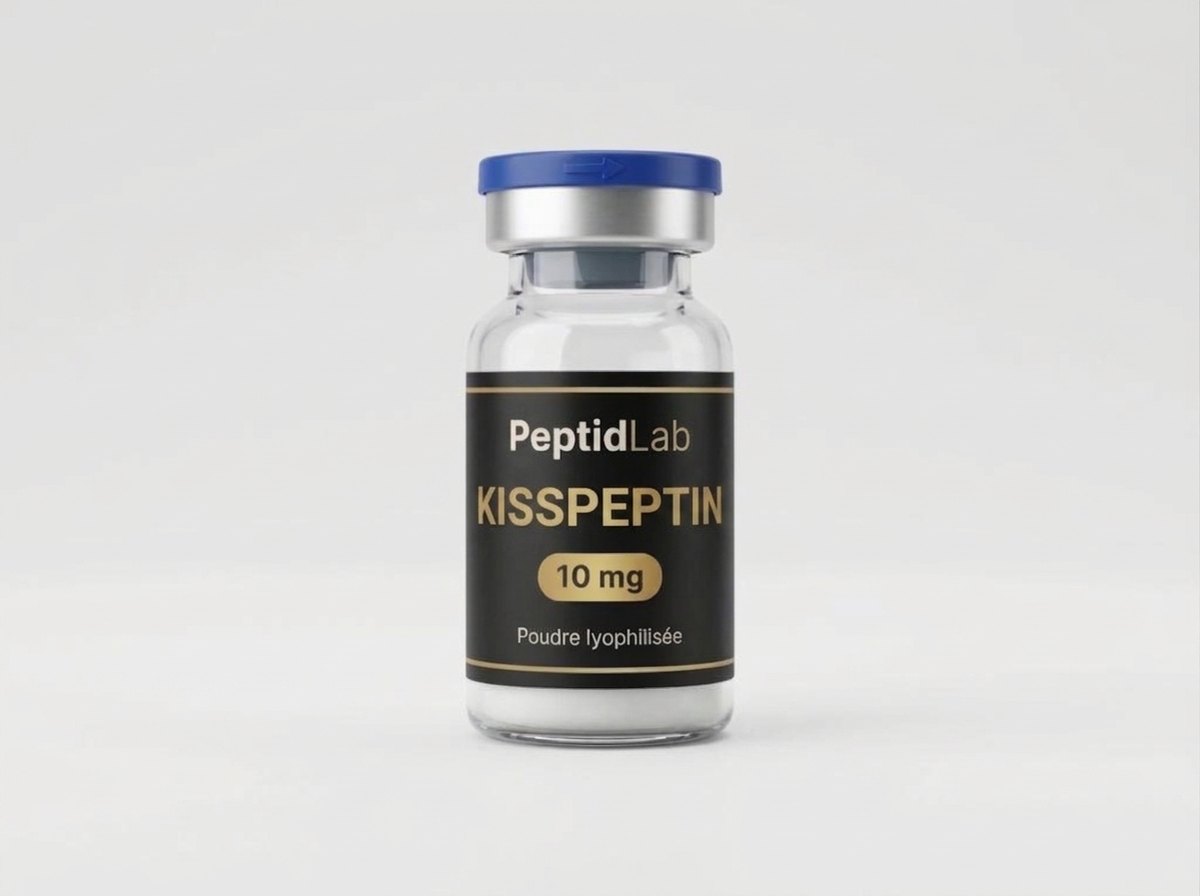
Kisspeptin is neither FSH nor HCG: it acts higher up, at the level of the hypothalamus. It has no marketing authorisation and is still used within clinical studies. The PeptidLab vial is a laboratory reagent.
Fact sheet
- Last name
- Kisspeptin-10 (metastin 45-54)
- Sequence
- YNWNSFGLRF-NH2 (10 amino acids)
- Molar mass
- 1 302,4 g/mol
- N° CAS
- 374675-21-5
- Gene
- KISS1
- Receptor or target
- KISS1R (formerly GPR54)
- Regulatory status
- No marketing authorisation; studied in clinical research
What the research says
Summary of published data, written by the PeptidLab team. It describes molecules studied in the laboratory or in clinical trials: nothing here is an indication for use.
2003Human studyN Engl J Med
Mutations in the GPR54 receptor prevent puberty: kisspeptin becomes a central regulator of the reproductive axis.
2003Human studyProc Natl Acad Sci USA
A second team independently describes hypogonadism linked to loss of function of the GPR54 receptor.
2005Human studyJ Clin Endocrinol Metab
In healthy men, kisspeptin-54 increases LH, FSH and testosterone.
2015Phase 2J Clin Endocrinol Metab
In IVF, kisspeptin-54 triggers egg maturation in women at high risk of ovarian hyperstimulation.
Safety: what studies report
- In published clinical studies, kisspeptin was well tolerated over short periods.
Sources
Links to PubMed or to the original document. Articles in English.
- Seminara SB et al. The GPR54 gene as a regulator of puberty. N Engl J Med, 2003. PubMed
- de Roux N et al. Hypogonadotropic hypogonadism due to loss of function of the KiSS1-derived peptide receptor GPR54. Proc Natl Acad Sci USA, 2003. PubMed
- Dhillo WS et al. Kisspeptin-54 stimulates the hypothalamic-pituitary gonadal axis in human males. J Clin Endocrinol Metab, 2005. PubMed
- Abbara A et al. Efficacy of Kisspeptin-54 to Trigger Oocyte Maturation in Women at High Risk of Ovarian Hyperstimulation Syndrome (OHSS) During In Vitro Fertilization (IVF) Therapy. J Clin Endocrinol Metab, 2015. PubMed
Updated October 2026.
Frequently asked questions
Why is it called "kiss"?
The gene was discovered in Hershey, the town of "Kisses" chocolates: its discoverers gave it this name as a nod to them.
What is the difference between kisspeptin-10 and kisspeptin-54?
The length of the chain. Both share the same active end; the short form acts for a shorter time in the blood.
Is kisspeptin a medicine?
No. It is being studied in clinical trials but has no marketing authorisation.
This guide has an informative and scientific purpose. PeptidLab products are intended exclusively for laboratory research and are not intended for human or animal consumption.