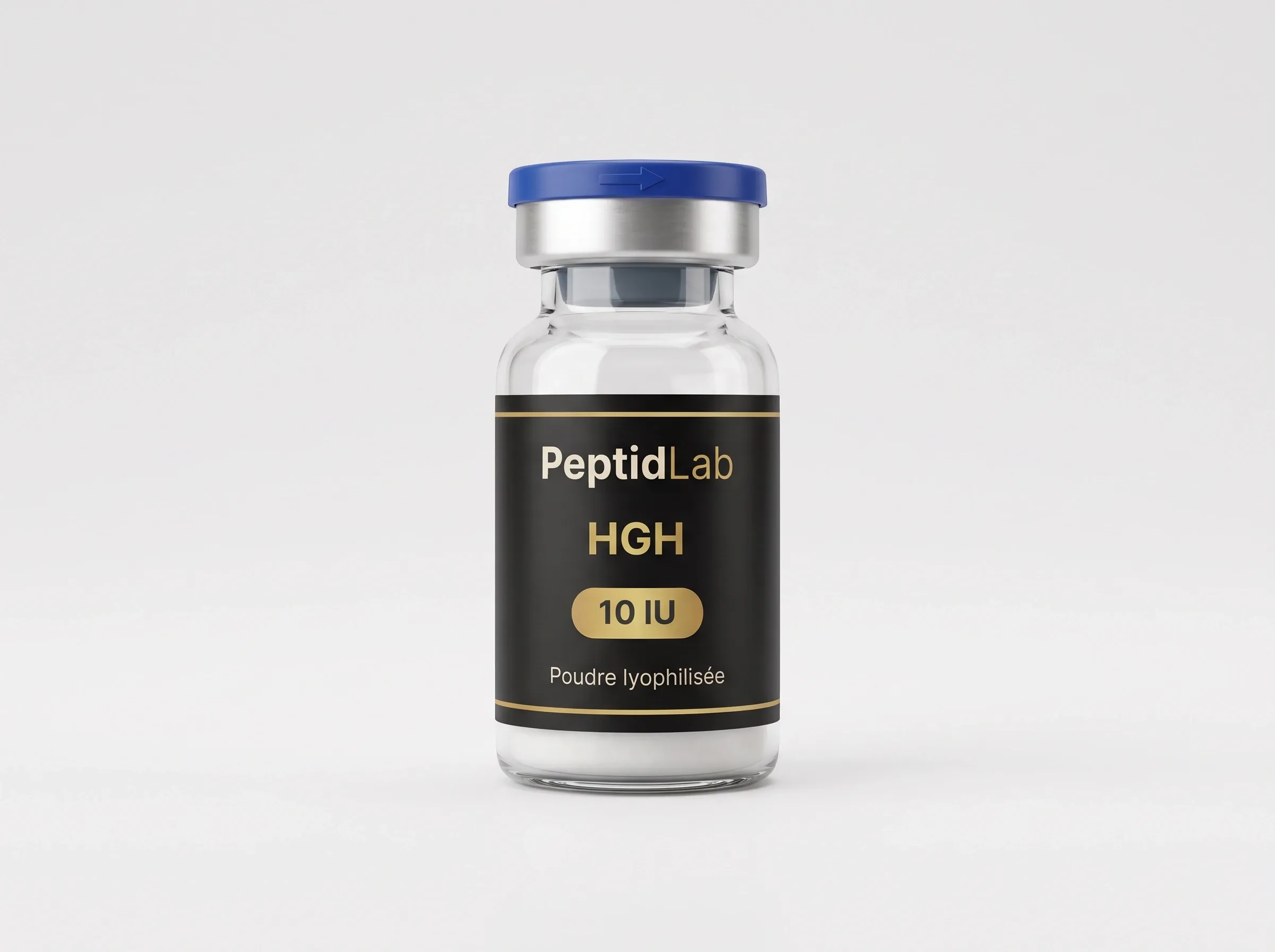
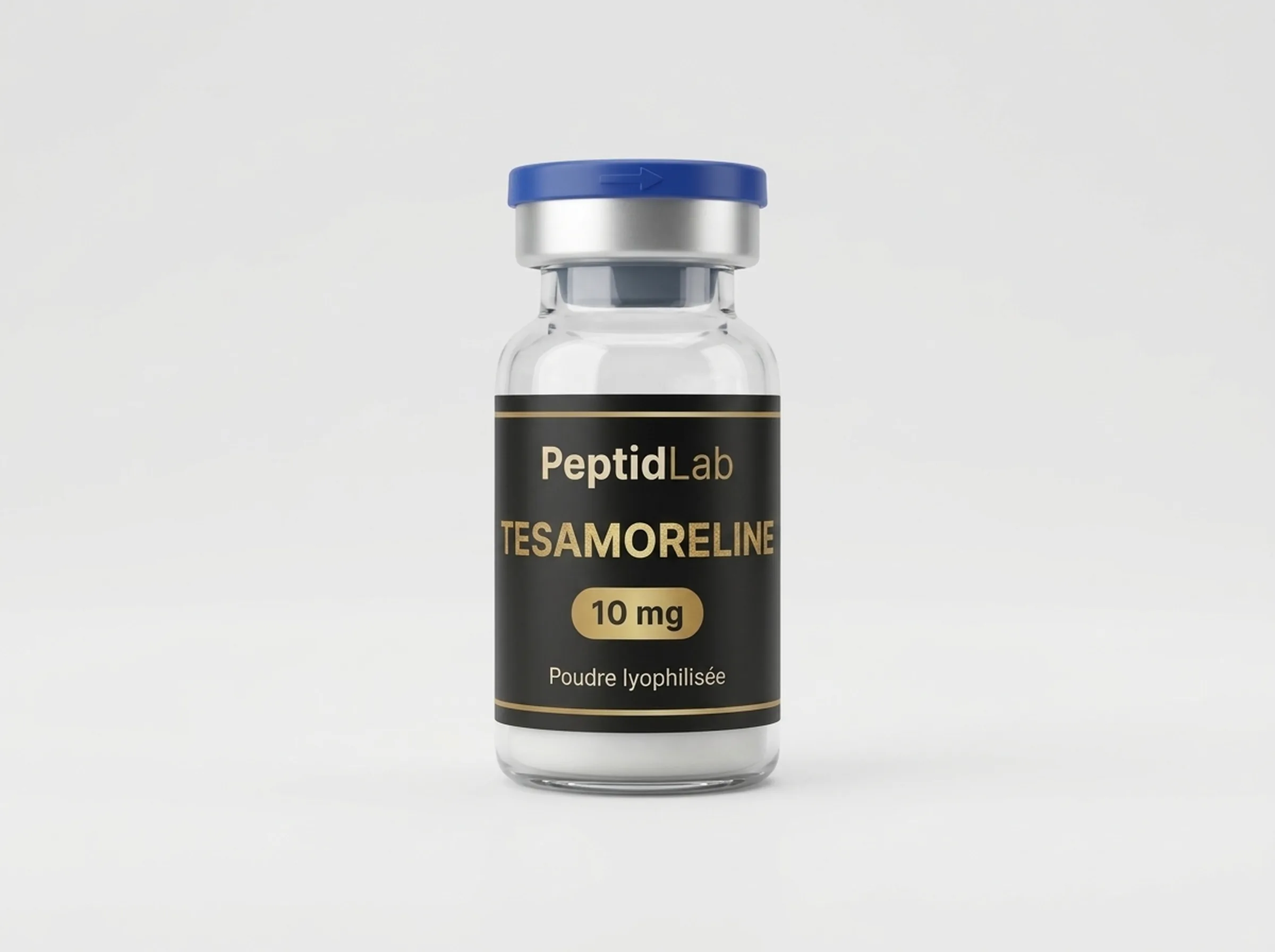
The HGH and the tesamorelin are often presented as two versions of the same subject. This is incorrect: one is growth hormone, the other is the signal that triggers it. This difference in level of action explains everything else.
The growth hormone axis, in three stages
Growth hormone production follows a cascade. The hypothalamus, at the base of the brain, releases GHRH (growth hormone releasing hormone). This orders the pituitary to secrete the growth hormone, which in turn acts on the tissues, largely through a second messenger produced by the liver, the IGF-1.
This cascade is regulated: when growth hormone and IGF-1 rise, the body itself slows down the following secretion, by a hormone called somatostatin. This is the point which fundamentally distinguishes the two molecules in question here.
HGH: the hormone itself
Human growth hormone is a protein of 191 amino acids, of approximately 22 kilodaltons, produced naturally by the pituitary gland. The so-called version recombinant is manufactured by biotechnology, from cells programmed to produce a protein with a sequence identical to the human hormone.
It is measured in international units (UI, or IU in English), a unit which expresses biological activity rather than a mass – a legacy of the time when the hormone was extracted from tissues, and where two batches did not have exactly the same activity.
Brought from outside, it no longer depends on the body's regulation: it bypasses the pituitary gland. This is what makes it a reference tool in experimental endocrinology, and also what makes it more difficult to study without disrupting the entire axis.
Tesamorelin: a signal, not a hormone
Tesamorelin takes over the 44 amino acids of human GHRH, with a chemical addition — a trans-3-hexenoyl group — which makes it more resistant to degradation by blood enzymes. Natural GHRH is destroyed within minutes; this stabilization is the entire reason for the existence of the molecule.
As it acts on the level above, the secretion it causes remains subject to the body's natural brakes: it retains the character pulsatile of physiological secretion, where a direct supply of hormone produces a continuous level. This is the difference that research most often highlights.
Tesamorelin is also one of the rare molecules in this family to have passed all stages of clinical trials: it has been authorized in the United States since 2010, under the name Egrifta, for a specific indication — lipodystrophy associated with HIV. This authorization concerns a medicine manufactured and controlled as such, not the vials sold as research peptides.
The differences at a glance
| HGH | Tesamorelin | |
|---|---|---|
| Nature | Recombinant growth hormone | Analogue of GHRH |
| Size | 191 amino acids (~22 kDa) | 44 amino acids |
| Action level | Directly on fabrics | On the pituitary gland, upstream |
| Natural regulation | Bypassed | Preserved (pulsatile secretion) |
| Unit of measurement | UI (international units) | Milligrams |
| Medication status | Authorized in GH deficiency | Authorized in the United States (HIV) |
| Anti-doping list | Permanently banned | Permanently banned |
What this changes for conservation
Both arrive in the form of freeze-dried powder, a state in which a peptide is stable for a long time protected from light. HGH, a much larger protein, is on the other hand more fragile once put back into solution: proteins of this size do not tolerate heat, vigorous stirring and freezing cycles. The subject is detailed in our guide on storage of lyophilized peptides.
Where does research stand?
Growth hormone has been studied since the 1950s and is one of the best documented proteins in endocrinology. Tesamorelin has solid clinical trials, but on a specific population and indication; outside of this framework, data remains limited.
Neither is authorized in France as a consumer product, and the vials sold here are intended exclusively for laboratory research. To check what a vial actually contains, the only valid document is the batch analysis report: our guide explains how to read a certificate of analysis.
Fact sheet
- HGH (somatropin)
- 191 amino acids, about 22 kDa, produced by recombinant technology
- CAS number of somatropin
- 12629-01-5
- Tesamorelin
- 44-amino-acid GHRH analogue with a trans-3-hexenoyl group
- CAS number of tesamorelin
- 218949-48-5
- Published half-life
- Tesamorelin: 26 to 38 minutes
- Regulatory status
- Somatropin authorised (growth hormone deficiency); tesamorelin authorised in the United States (Egrifta, 2010)
- Anti-doping status (WADA)
- Prohibited at all times (class S2)
What the research says
Summary of published data, written by the PeptidLab team. It describes molecules studied in the laboratory or in clinical trials: nothing here is an indication for use.
1985ApprovalFDA
First recombinant human growth hormone authorised in the United States, replacing hormone extracted from pituitary glands.
2007Phase 3N Engl J Med
Tesamorelin in 412 patients living with HIV: visceral fat reduced by about 15% in 26 weeks, with no notable effect on subcutaneous fat.
2011GuidelineJ Clin Endocrinol Metab
Endocrine Society guidelines on the diagnosis and treatment of adult growth hormone deficiency.
2014Randomised trialJAMA
Tesamorelin: reduction in visceral fat and liver fat in patients living with HIV.
Safety: what studies report
- Growth hormone: fluid retention, joint and muscle pain, carpal tunnel syndrome and reduced insulin sensitivity are described in the package leaflets.
- Tesamorelin: injection-site reactions, joint pain and increases in IGF-1 and blood glucose, according to the trials.
Sources
Links to PubMed or to the original document. Articles in English.
- Falutz J et al. Metabolic effects of a growth hormone-releasing factor in patients with HIV. N Engl J Med, 2007. PubMed
- Molitch ME et al. Evaluation and treatment of adult growth hormone deficiency: an Endocrine Society clinical practice guideline. J Clin Endocrinol Metab, 2011. PubMed
- Stanley TL et al. Effect of tesamorelin on visceral fat and liver fat in HIV-infected patients with abdominal fat accumulation: a randomized clinical trial. JAMA, 2014. PubMed
Updated October 2026.
Frequently asked questions
What is the difference between HGH and tesamorelin?
HGH is the growth hormone itself. Tesamorelin is an analogue of GHRH: it acts upstream, on the pituitary gland, which then releases its own growth hormone.
Is tesamorelin a medicine?
In the United States, tesamorelin has been authorized since 2010 under the name Egrifta, for a specific indication related to HIV. Vials sold as research peptides are not medicines and have no marketing authorization.
Why is HGH measured in IU and tesamorelin in milligrams?
The IU (international unit) measures biological activity, historically used for extracted hormones. Tesamorelin, a synthetic peptide, is measured simply by its mass.
Are these two products banned in sport?
Yes. Both growth hormone and GHRH analogues are on the World Anti-Doping Agency's banned list, permanently and not just in competition.
This guide has an informative and scientific purpose. PeptidLab products are intended exclusively for laboratory research and are not intended for human or animal consumption.