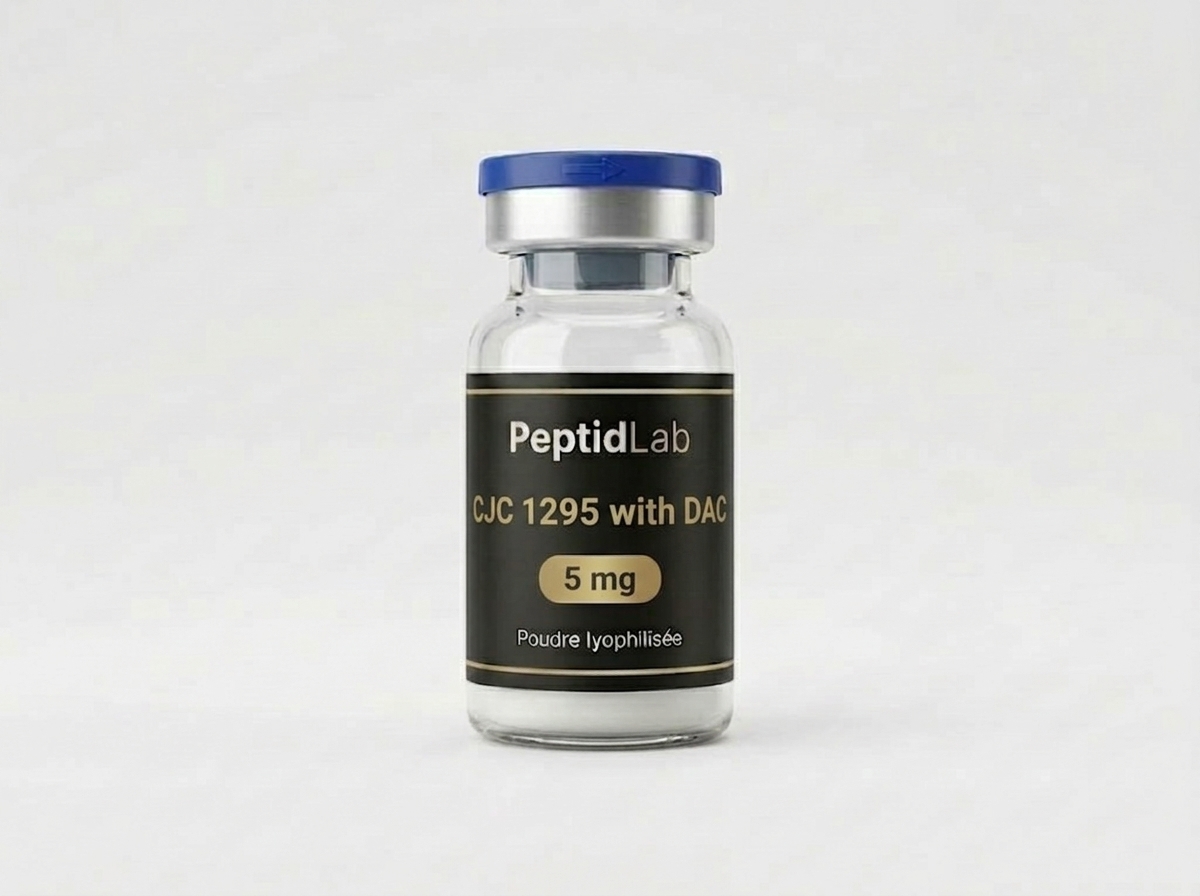
Click a product. Load a dilution. Read the volume and the mark on the syringe. These schedules reproduce doses published for laboratory research. They are not prescriptions, and the vials are not medicines.
Choose a peptide on the left. The diagram (doses and frequency), the dilutions and the calculator are loaded together.
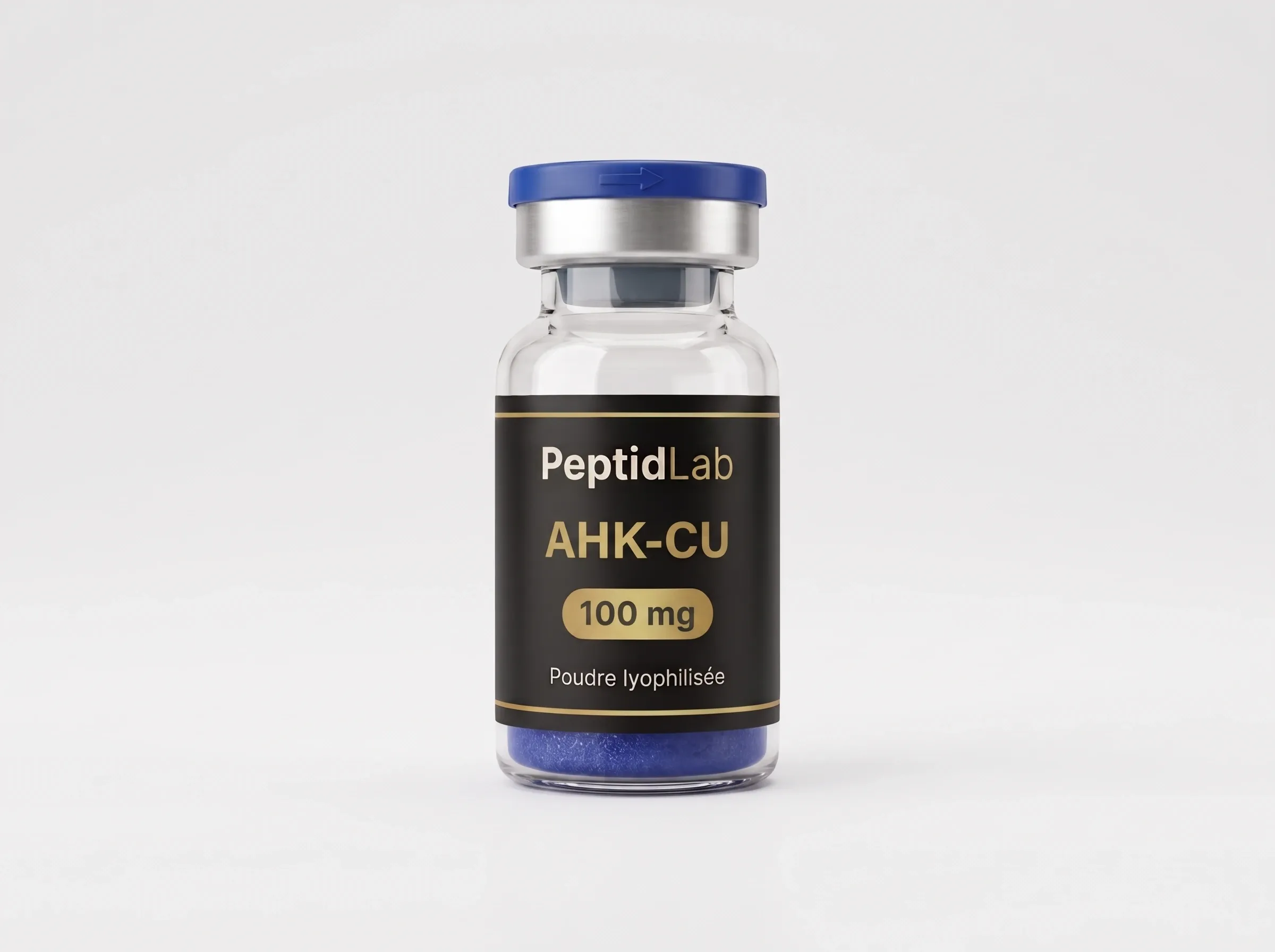
Ala-His-Lys copper tripeptide, close to GHK-Cu. Same reconstitution logic as the copper peptides in the catalog: working volumes 5 or 10 mL for 100 mg.
Literature: especially cellular and animal work on the dermal papilla and the hair follicle. Less data than GHK-Cu. No drug marketing authorization.
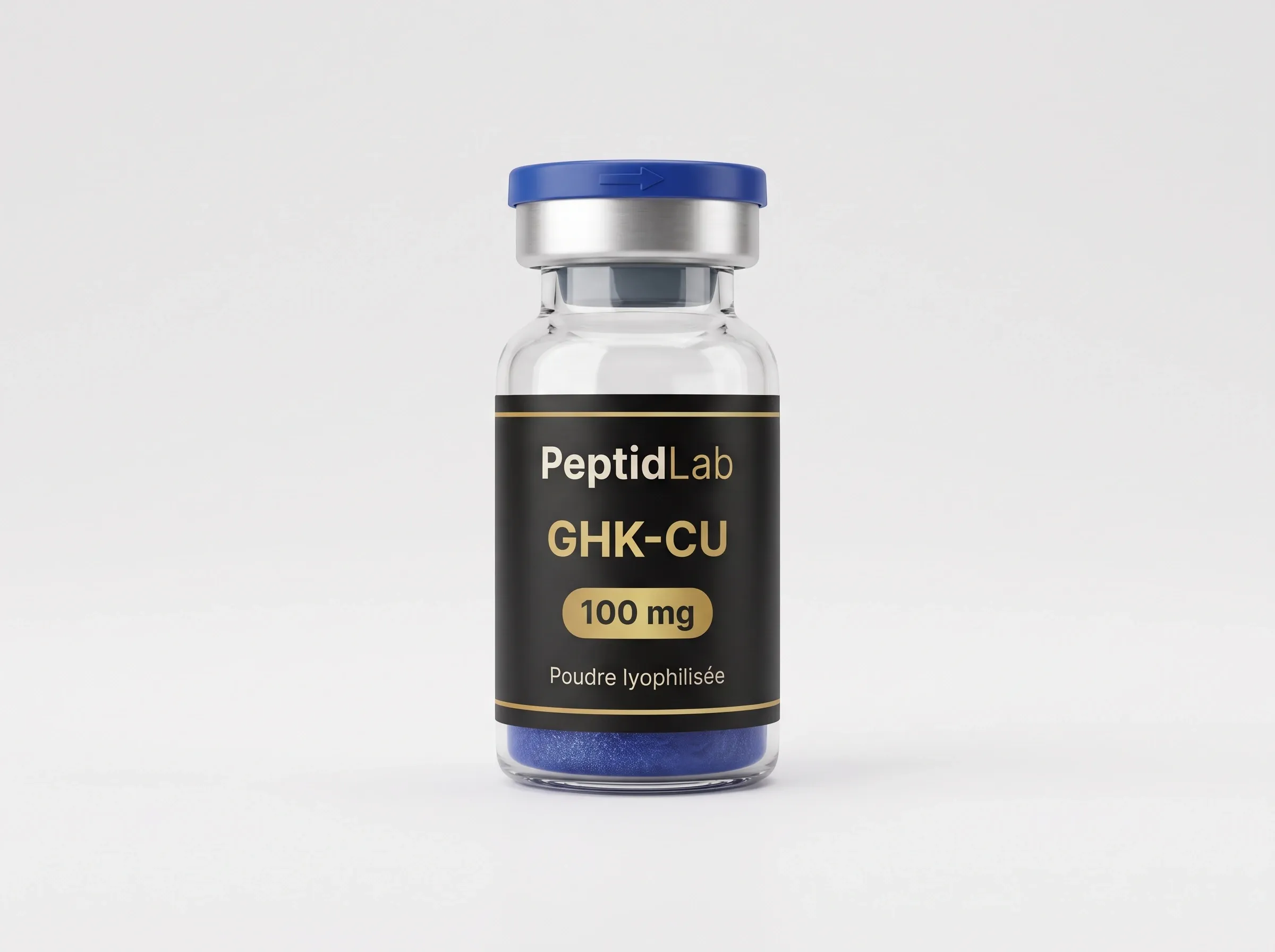
The powder is often blue (Cu²⁺ ion). Examples: 100 mg in 5 mL (20 mg/mL) or 10 mL (10 mg/mL).
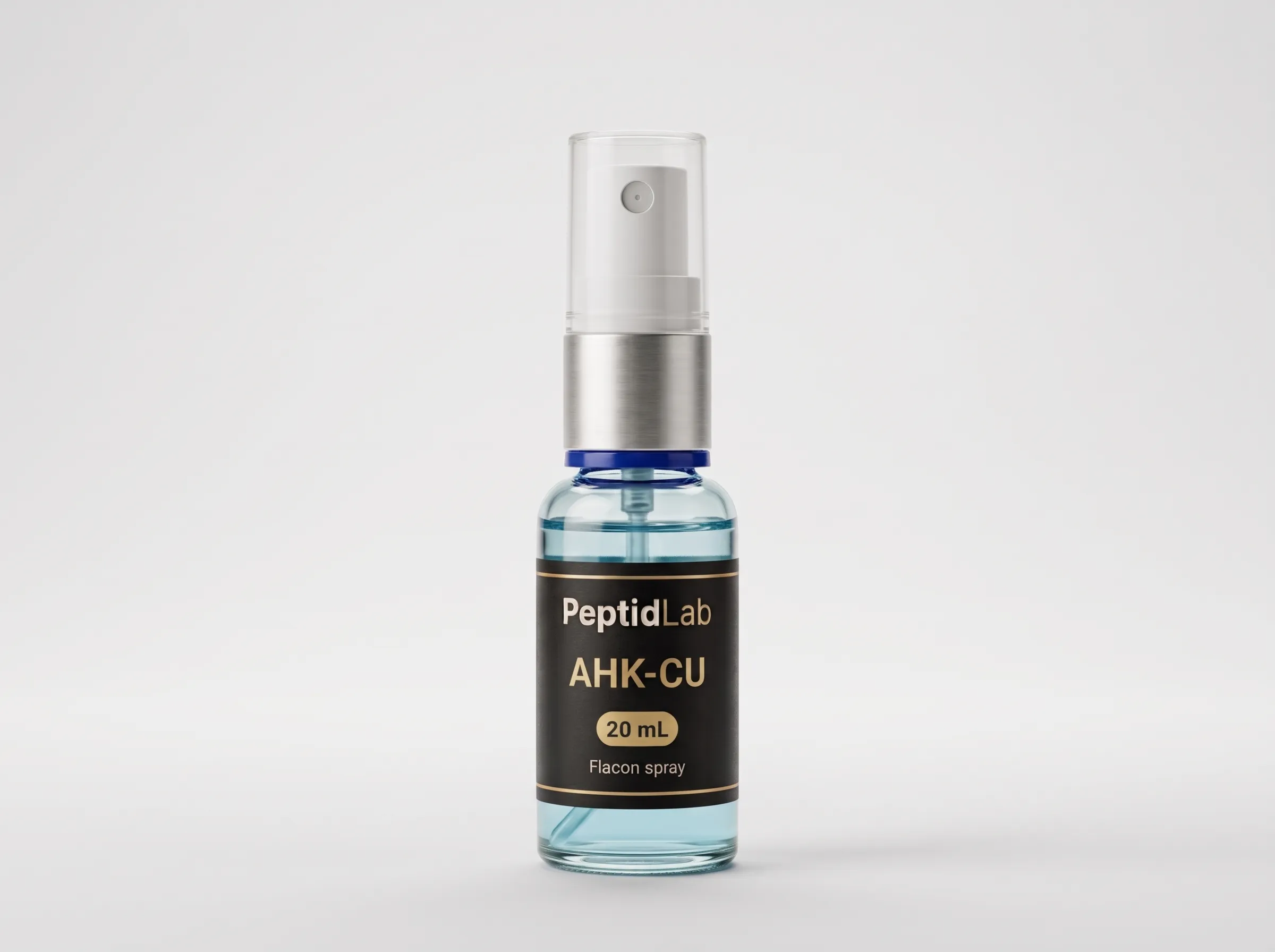
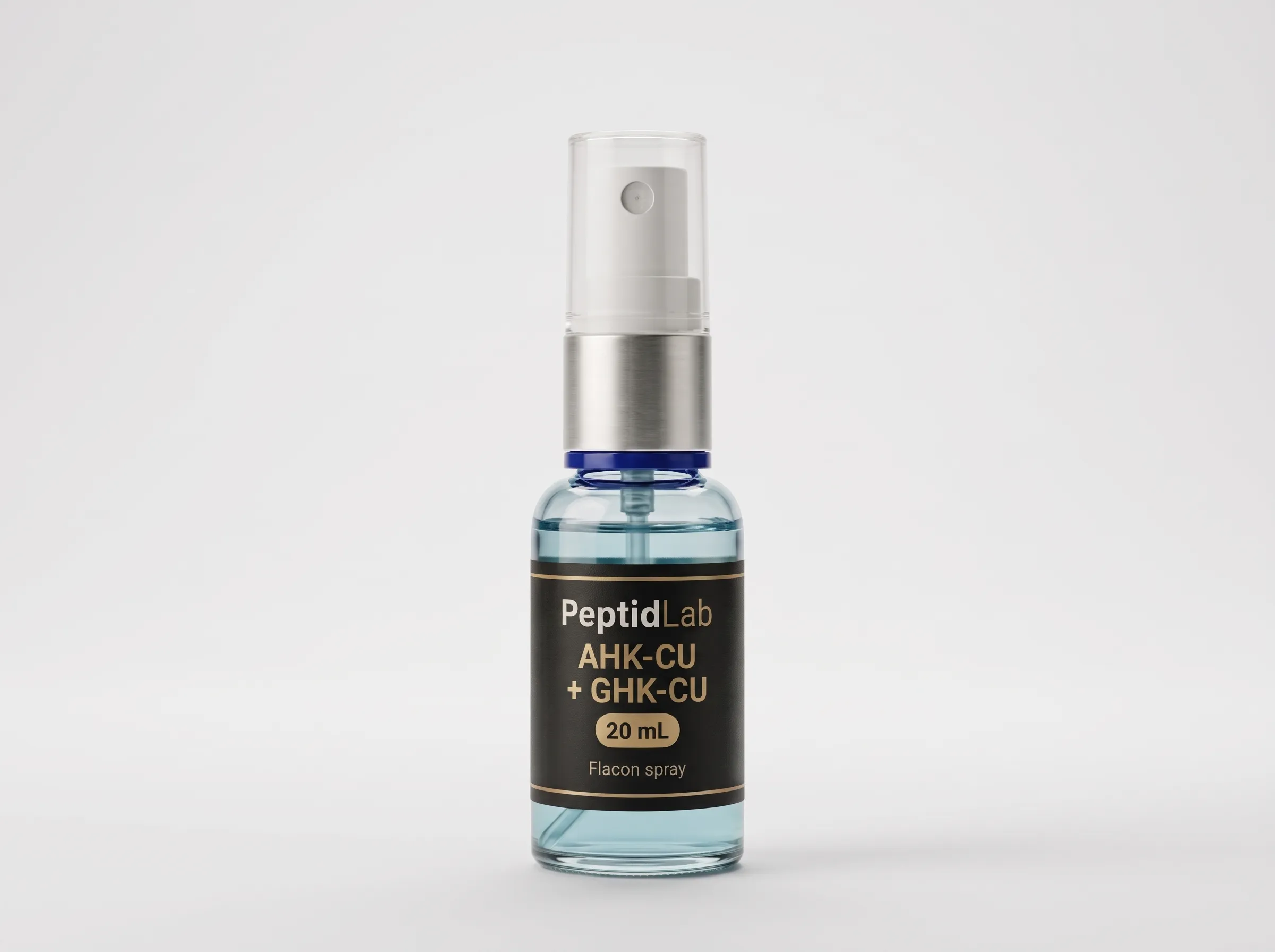
A pen format also exists for this peptide: already in solution, without reconstitution. See the pens.
Titration scheme
Same rate as GHK-Cu (copper peptide).
AHK-Cu regimen: levels, dose and frequency
Period
Step
Dose
Frequency
Weeks 1 to 2
Adjustment
1.0 mg / day
1× / day
Weeks 3 to 6
Optimal step
2.0 mg / day
1× / day
Weeks 7+
Break
Break of at least 4 weeks
—
Subcutaneous injection
1 Clean the injection site with an alcohol swab (abdomen 5 cm from the navel, thigh or upper arm).
2 Withdraw the indicated amount in units into a U-100 insulin syringe (1 mL = 100 IU).
3 Lightly pinch the skin fold and insert the fine needle at 45° or 90°.
4 Push the plunger slowly, hold for 5 seconds, then remove the needle.
5 Change area with each injection.
Dilution examples for AHK-Cu
Vial
Solvent
Concentration
Apply
100 mg
5 mL
20 mg/mL
100 mg
10 mL
10 mg/mL
Handling
1 Disinfect the caps of the vial and the solvent bottle with a 70° alcohol pad.
2 Take the volume of solvent provided for in your method, with a sterile syringe.
3 Inject the liquid slowly along the inner wall, to preserve the lyophilisate.
4 Roll the vial between your palms until dissolved. Do not shake.
5 Note on the label the date of reconstitution, the volume added and the batch number.
The calculator below is the same as on the dedicated page. Load a row from the table, then a quantity to convert.
Before reconstitution
2 to 8°C, protected from light, in the original packaging.
After reconstitution / in solution
2 to 8°C after reconstitution. In these sheets: up to 28 to 30 days (14 to 21 days for HGH).
PeptideGuides reference for a 10 IU vial, reconstituted with 3 mL. The source table is in micrograms of mass: 1 mg of HGH ≈ 3 IU, so 200 µg ≈ 0.6 IU and 1,000 µg ≈ 3 IU.
Examples: 1 mL → 10 IU/mL, or 2 mL → 5 IU/mL.
A pen format also exists for this peptide: already in solution, without reconstitution. See the pens.
Titration scheme
PeptideGuides reference for a 10 IU vial, reconstituted with 3 mL. The source table is in micrograms of mass: 1 mg of HGH ≈ 3 IU, so 200 µg ≈ 0.6 IU and 1,000 µg ≈ 3 IU.
HGH regimen: levels, dose and frequency
Period
Step
Dose
Frequency
Week 1
Step 1
0.6 IU / day (200 µg)
1× / day
Week 2
Step 2
0.9 IU / day (300 µg)
1× / day
Weeks 3 to 4
Step 3
1.2 to 1.5 IU / day
1× / day
Weeks 5 to 8
Step 4
1.8 to 2.7 IU / day
1× / day
Week 9+
Top step
3 IU / day (1 mg)
1× / day
Subcutaneous injection
1 Clean the injection site with an alcohol swab (abdomen 5 cm from the navel, thigh or upper arm).
2 Withdraw the indicated amount in units into a U-100 insulin syringe (1 mL = 100 IU).
3 Lightly pinch the skin fold and insert the fine needle at 45° or 90°.
4 Push the plunger slowly, hold for 5 seconds, then remove the needle.
5 Change area with each injection.
Dilution Examples for HGH
Vial
Solvent
Concentration
Apply
10 UI
3 mL
3,33 UI/mL
12 UI
3,6 mL
3,33 UI/mL
15 UI
4,5 mL
3,33 UI/mL
20 UI
6 mL
3,33 UI/mL
24 UI
7,2 mL
3,33 UI/mL
36 UI
10,8 mL
3,33 UI/mL
Handling
1 Disinfect the caps of the vial and the solvent bottle with a 70° alcohol pad.
2 Take the volume of solvent provided for in your method, with a sterile syringe.
3 Inject the liquid slowly along the inner wall, to preserve the lyophilisate.
4 Roll the vial between your palms until dissolved. Do not shake.
5 Note on the label the date of reconstitution, the volume added and the batch number.
The calculator below is the same as on the dedicated page. Load a row from the table, then a quantity to convert.
Before reconstitution
2 to 8°C, protected from light, in the original packaging.
After reconstitution / in solution
2 to 8°C. Ideally 14 to 21 days after reconstitution.
PeptideGuides reference: once a day, 100 to 250 µg (the range cited goes up to 300 µg). 10 mg vial in 3 mL (about 3.33 mg/mL). The 5 mg vial is reconstituted with 3 mL (about 1.67 mg/mL), same schedule.
Works published mainly on the release of GH. Scheme: 1 to 2 doses per day.
Titration scheme
PeptideGuides reference: once a day, 100 to 250 µg (the range cited goes up to 300 µg). 10 mg vial in 3 mL (about 3.33 mg/mL). The 5 mg vial is reconstituted with 3 mL (about 1.67 mg/mL), same schedule.
Ipamorelin regimen: levels, dose and frequency
Period
Step
Dose
Frequency
Weeks 1 to 2
Step 1
100 µg / day
1× / day
Weeks 3 to 4
Step 2
150 µg / day
1× / day
Weeks 5 to 8
Step 3
200 µg / day
1× / day
Weeks 9 to 12
Step 4
250 µg / day
1× / day
Subcutaneous injection
1 Clean the injection site with an alcohol swab (abdomen 5 cm from the navel, thigh or upper arm).
2 Withdraw the indicated amount in units into a U-100 insulin syringe (1 mL = 100 IU).
3 Lightly pinch the skin fold and insert the fine needle at 45° or 90°.
4 Push the plunger slowly, hold for 5 seconds, then remove the needle.
5 Change area with each injection.
Dilution examples for Ipamorelin
Vial
Solvent
Concentration
Apply
10 mg
3 mL
3,33 mg/mL
Handling
1 Disinfect the caps of the vial and the solvent bottle with a 70° alcohol pad.
2 Take the volume of solvent provided for in your method, with a sterile syringe.
3 Inject the liquid slowly along the inner wall, to preserve the lyophilisate.
4 Roll the vial between your palms until dissolved. Do not shake.
5 Note on the label the date of reconstitution, the volume added and the batch number.
The calculator below is the same as on the dedicated page. Load a row from the table, then a quantity to convert.
Before reconstitution
2 to 8°C, protected from light, in the original packaging.
After reconstitution / in solution
2 to 8°C after reconstitution. In these sheets: up to 28 to 30 days (14 to 21 days for HGH).
Afamelanotide / melanotan I: α-MSH analogue. In Europe, afamelanotide has marketing authorization in the form of an implant (Scenesse) for a very precise indication – it is not this research vial.
Do not confuse with medicinal implant. The sheet only converts mass to volume for the laboratory.
Research lyophilisate 10 mg: 2 mL (5 mg/mL) or 4 mL (2.5 mg/mL), solvent according to batch document.
Titration scheme
Analog α-MSH: adaptation then more spaced rhythm.
MT-1 scheme: levels, dose and frequency
Period
Step
Dose
Frequency
Weeks 1 to 2
Adjustment
0.25 mg / day
1× / day
Weeks 3 to 8
Maintenance
0,50 mg
1× / 2 days
Weeks 9+
Break
4-week break
—
Subcutaneous injection
1 Clean the injection site with an alcohol swab (abdomen 5 cm from the navel, thigh or upper arm).
2 Withdraw the indicated amount in units into a U-100 insulin syringe (1 mL = 100 IU).
3 Lightly pinch the skin fold and insert the fine needle at 45° or 90°.
4 Push the plunger slowly, hold for 5 seconds, then remove the needle.
5 Change area with each injection.
Dilution Examples for MT-1
Vial
Solvent
Concentration
Apply
10 mg
2 mL
5 mg/mL
10 mg
4 mL
2,5 mg/mL
Handling
1 Disinfect the caps of the vial and the solvent bottle with a 70° alcohol pad.
2 Take the volume of solvent provided for in your method, with a sterile syringe.
3 Inject the liquid slowly along the inner wall, to preserve the lyophilisate.
4 Roll the vial between your palms until dissolved. Do not shake.
5 Note on the label the date of reconstitution, the volume added and the batch number.
The calculator below is the same as on the dedicated page. Load a row from the table, then a quantity to convert.
Before reconstitution
2 to 8°C, protected from light, in the original packaging.
After reconstitution / in solution
2 to 8°C after reconstitution. In these sheets: up to 28 to 30 days (14 to 21 days for HGH).
PeptideGuides reference: daily rise from 250 µg to 1 mg. 10 mg vial in 3 mL (about 3.33 mg/mL). The molecule is photosensitive: no harsh sun exposure in the protocol.
No clinical protocol to repeat. Aliquots are mass conversions for a documented experimental design.
2 mL (5 mg/mL) or 4 mL (2.5 mg/mL). Protect from light like other α-MSH analogues.
Titration scheme
PeptideGuides reference: daily rise from 250 µg to 1 mg. 10 mg vial in 3 mL (about 3.33 mg/mL). The molecule is photosensitive: no harsh sun exposure in the protocol.
MT-2 scheme: levels, dose and frequency
Period
Step
Dose
Frequency
Week 1
Step 1
250 µg / day
1× / day
Week 2
Step 2
500 µg / day
1× / day
Week 3
Step 3
750 µg / day
1× / day
Weeks 4 to 8
Step 4
1,000 µg (1 mg) / day
1× / day
Subcutaneous injection
1 Clean the injection site with an alcohol swab (abdomen 5 cm from the navel, thigh or upper arm).
2 Withdraw the indicated amount in units into a U-100 insulin syringe (1 mL = 100 IU).
3 Lightly pinch the skin fold and insert the fine needle at 45° or 90°.
4 Push the plunger slowly, hold for 5 seconds, then remove the needle.
5 Change area with each injection.
Dilution Examples for MT-2
Vial
Solvent
Concentration
Apply
10 mg
3 mL
3,33 mg/mL
Handling
1 Disinfect the caps of the vial and the solvent bottle with a 70° alcohol pad.
2 Take the volume of solvent provided for in your method, with a sterile syringe.
3 Inject the liquid slowly along the inner wall, to preserve the lyophilisate.
4 Roll the vial between your palms until dissolved. Do not shake.
5 Note on the label the date of reconstitution, the volume added and the batch number.
The calculator below is the same as on the dedicated page. Load a row from the table, then a quantity to convert.
Before reconstitution
2 to 8°C, away from light (photosensitive).
After reconstitution / in solution
2 to 8°C after reconstitution. In these sheets: up to 28 to 30 days (14 to 21 days for HGH).
Nicotinamide adenine dinucleotide, redox cofactor. In research, lyophilisate is sensitive to light and oxidation. 100 mg vial.
Hospital infusions of NAD+ fall into a different framework. Here: reconstitution of research powder only.
2 mL (50 mg/mL) or 5 mL (20 mg/mL). Prepare away from strong light. NAD+ in solution degrades faster than many peptides: aliquot if your method provides for it.
Titration scheme
Cofactor: several doses per week rather than a GLP-1 titration.
NAD+ regimen: levels, dose and frequency
Period
Step
Dose
Frequency
Weeks 1 to 2
Adjustment
25 mg / dose
2× / week
Weeks 3 to 8
Maintenance
50 mg / dose
2 to 3 times / week
Weeks 9+
Break
Break 2 to 4 weeks
—
Subcutaneous injection
1 Clean the injection site with an alcohol swab (abdomen 5 cm from the navel, thigh or upper arm).
2 Withdraw the indicated amount in units into a U-100 insulin syringe (1 mL = 100 IU).
3 Lightly pinch the skin fold and insert the fine needle at 45° or 90°.
4 Push the plunger slowly, hold for 5 seconds, then remove the needle.
5 Change area with each injection.
Dilution Examples for NAD+
Vial
Solvent
Concentration
Apply
100 mg
2 mL
50 mg/mL
100 mg
5 mL
20 mg/mL
Handling
1 Work away from intense direct light.
2 Disinfect the caps, add the solvent along the wall, do not shake.
3 Check complete dissolution and appearance (no particles).
4 Note date, volume, concentration. Aliquot rather than reopening the vial often.
The calculator below is the same as on the dedicated page. Load a row from the table, then a quantity to convert.
Before reconstitution
2 to 8°C, dry, protected from light.
After reconstitution / in solution
2 to 8°C, protected from light. Stability often short: refer to the batch. Avoid freeze–thaw cycles.
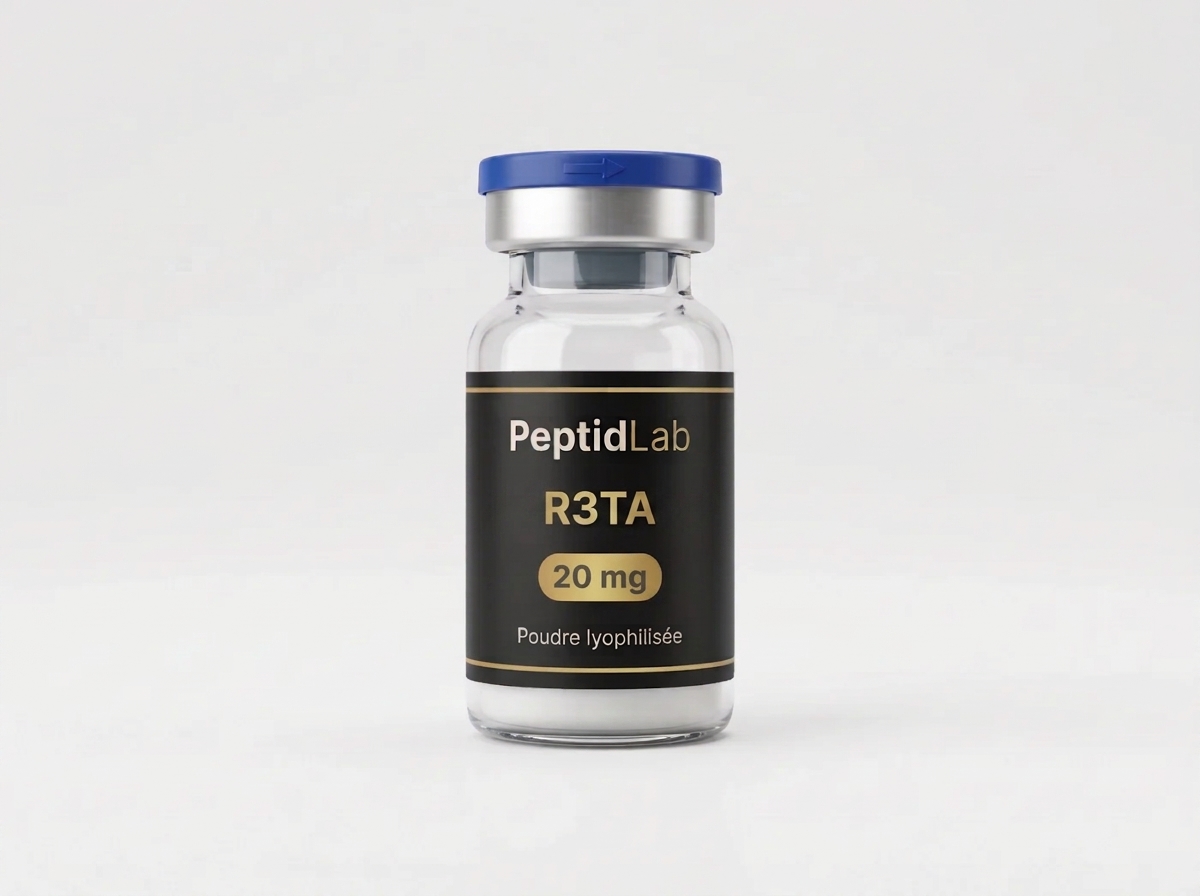
10 mg vial in 1 mL (10 mg/mL). This page's original escalation, one injection per week, always on the same day: 0.5 mg, then 1 mg, 2 mg, then 4 to 12 mg. Larger vials keep the same concentration if 1 mL is added per 10 mg.
1 mL of bacteriostatic water for each 10 mg. At 10 mg/mL, 1 mg corresponds to 0.10 mL, or 10 graduations on a 1 mL/100 syringe.
Titration scheme
10 mg vial in 1 mL (10 mg/mL). This page's original escalation, one injection per week, always on the same day: 0.5 mg, then 1 mg, 2 mg, then 4 to 12 mg. Larger vials keep the same concentration if 1 mL is added per 10 mg.
R3TA regimen: levels, dose and frequency
Period
Step
Dose
Frequency
Weeks 1 to 4
Step 1
0.5 mg / week
1× / week
Weeks 5 to 8
Step 2
1.0 mg / week
1× / week
Weeks 9 to 12
Step 3
2.0 mg / week
1× / week
Weeks 13+
Maintenance
4 to 12 mg/week
1× / week
Subcutaneous injection
1 Clean the injection site with an alcohol swab (abdomen 5 cm from the navel, thigh or upper arm).
2 Withdraw the indicated amount in units into a U-100 insulin syringe (1 mL = 100 IU).
3 Lightly pinch the skin fold and insert the fine needle at 45° or 90°.
4 Push the plunger slowly, hold for 5 seconds, then remove the needle.
5 Change area with each injection.
Dilution Examples for R3TA
Vial
Solvent
Concentration
Apply
10 mg
1 mL
10 mg/mL
20 mg
2 mL
10 mg/mL
30 mg
3 mL
10 mg/mL
40 mg
4 mL
10 mg/mL
50 mg
5 mL
10 mg/mL
60 mg
6 mL
10 mg/mL
Handling
1 Disinfect the caps of the vial and the solvent bottle with a 70° alcohol pad.
2 Take the volume of solvent provided for in your method, with a sterile syringe.
3 Inject the liquid slowly along the inner wall, to preserve the lyophilisate.
4 Roll the vial between your palms until dissolved. Do not shake.
5 Note on the label the date of reconstitution, the volume added and the batch number.
The calculator below is the same as on the dedicated page. Load a row from the table, then a quantity to convert.
Before reconstitution
2 to 8°C, protected from light, in the original packaging.
After reconstitution / in solution
2 to 8°C after reconstitution. In these sheets: up to 28 to 30 days (14 to 21 days for HGH).
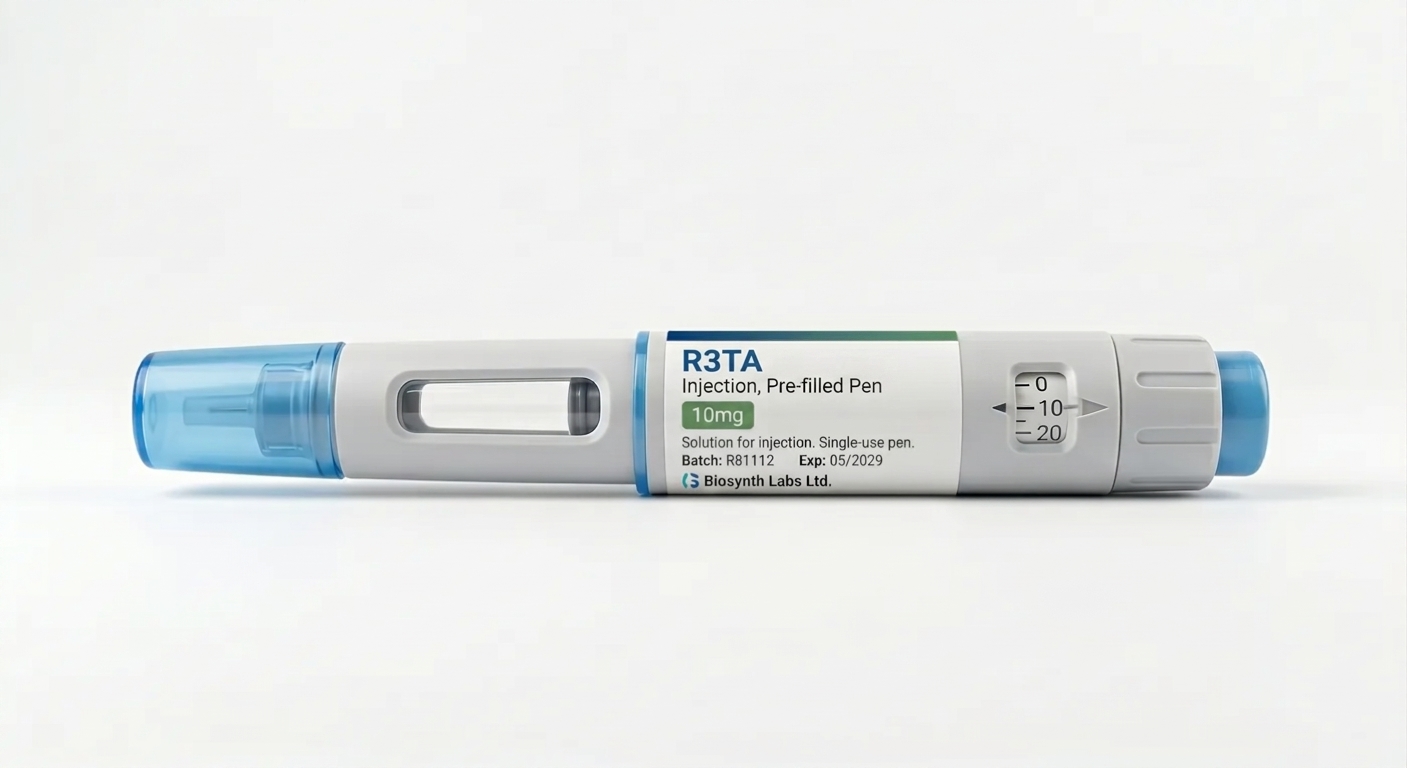
Same schedule as the vial: 0.5 mg, then 1 mg, 2 mg, then 4 to 12 mg per week. On the 10 mg / 3 mL pen, 24 clicks = 1 mg.
Conversion and storage according to the internal leaflet NOT-STYLO-10-3-v2. The weekly schedule is the same as for the vial: 24 clicks = 1 mg.
Concentration of the device: 10 mg in 3 ml. By proportionality, 1 mg corresponds to 0.3 ml. One notch (“click”) delivers 0.0125 ml; 1 mg = 24 clicks. Count clicks out loud to avoid volume error.
Titration scheme
Same schedule as the vial (0.5 mg, then 1 mg, 2 mg, then 4 to 12 mg). On the 10 mg / 3 mL pen: 24 clicks = 1 mg. Step 1 (0.5 mg) corresponds to 12 clicks.
R3TA Pen regimen: levels, dose and frequency
Period
Step
Dose
Frequency
Weeks 1 to 4
Step 1
0.5 mg / week
1× / week
Weeks 5 to 8
Step 2
1.0 mg / week
1× / week
Weeks 9 to 12
Step 3
2.0 mg / week
1× / week
Weeks 13+
Maintenance
4 to 12 mg/week
1× / week
To convert the threshold dose to clicks, open the Clicks tab (24 clicks = 1 mg).
Conversion 10 mg / 3 ml — 24 clicks = 1 mg
Quantity
Volume
Clicks
1 mg
0,3 ml
24
2 mg
0,6 ml
48
3 mg
0,9 ml
72
4 mg
1,2 ml
96
5 mg
1,5 ml
120
6 mg
1,8 ml
144
7 mg
2,1 ml
168
8 mg
2,4 ml
192
9 mg
2,7 ml
216
10 mg
3 ml
240
Handling the pen
1 Check the batch, the integrity of the pen and the appearance: clear and colorless solution, without particles.
2 Screw a new sterile needle onto the screw thread.
3 Flow test (purge) when first put into service: 2 clicks, needle upwards, press. A drop should bead. Otherwise, repeat up to 6 times maximum.
4 Turn the dial to the number of clicks in the table (24 clicks = 1 mg). Count out loud.
5 If you exceed: do not force. Turn the other direction to the desired value — this does not waste solution.
6 Press the trigger all the way (the mark returns to 0). Hold down and count to 10 before removing the needle, to completely empty the set volume.
7 Remove the needle, throw it into a sharps container, replace the cap.
Pen already in solution. Weekly pattern in the Pattern tab; conversion clicks below.
Convert a quantity
1 click = 0.0125 ml · 24 clicks = 1 mg
—
Pen Conversion Chart
Quantity
Volume
Clicks
1 mg
0,3 ml
24
2 mg
0,6 ml
48
3 mg
0,9 ml
72
4 mg
1,2 ml
96
5 mg
1,5 ml
120
6 mg
1,8 ml
144
7 mg
2,1 ml
168
8 mg
2,4 ml
192
9 mg
2,7 ml
216
10 mg
3 ml
240
Intermediate marks (ml window on some pens)
Volume
Clicks
Quantity
0.19 ml*
15
0,625 mg
0,375 ml
30
1,25 mg
0,5 ml
40
1,66 mg
0,75 ml
60
2,5 mg
* 0.19 ml rounded to 0.1875 ml
Before first use
Before first use: refrigerator 2 to 8°C. Do not freeze.
After first use
After first use: up to 30°C for the time indicated on the pack. Cap in place, protected from light. Always remove the needle after use.
10 mg vial in 2 mL (5 mg/mL). Days 1 and 2 at 2.5 mg, then 5 mg once a day.
Titration scheme
Days 1 and 2 at 2.5 mg, then 5 mg once a day. An alternative cited in laboratory sheets is 2.5 mg twice a day. 10 mg vial in 2 mL (5 mg/mL). 50 mg vial in 4 mL (12.5 mg/mL). 5 mg vial in 1 mL (5 mg/mL).
5-Amino-1MQ schedule: steps, dose and frequency
Period
Step
Dose
Frequency
Days 1 to 2
Tolerance
2.5 mg / day
1× / day
Then
Reference step
5 mg / day
1× / day
Alternative
Two doses
2.5 mg / dose
2× / day
Subcutaneous injection
1 Clean the injection site with an alcohol swab (abdomen 5 cm from the navel, thigh or upper arm).
2 Withdraw the indicated amount in units into a U-100 insulin syringe (1 mL = 100 IU).
3 Lightly pinch the skin fold and insert the fine needle at 45° or 90°.
4 Push the plunger slowly, hold for 5 seconds, then remove the needle.
5 Change area with each injection.
Dilution examples for 5-Amino-1MQ
Vial
Solvent
Concentration
Apply
5 mg
1 mL
5 mg/mL
10 mg
2 mL
5 mg/mL
50 mg
4 mL
12,5 mg/mL
Handling
1 Disinfect the caps of the vial and the solvent bottle with a 70° alcohol pad.
2 Take the volume of solvent provided for in your method, with a sterile syringe.
3 Inject the liquid slowly along the inner wall, to preserve the lyophilisate.
4 Roll the vial between your palms until dissolved. Do not shake.
5 Note on the label the date of reconstitution, the volume added and the batch number.
The calculator below is the same as on the dedicated page. Load a row from the table, then a quantity to convert.
Before reconstitution
2 to 8°C, protected from light, in the original packaging.
After reconstitution / in solution
2 to 8°C after reconstitution. In these sheets: up to 28 to 30 days (14 to 21 days for HGH).
Teichman 2006 trial, in µg/kg: 30, 60, 125 or 250 µg/kg as a single dose, then 30 or 60 µg/kg every 14 days. A 2 or 5 mg vial is a fixed mass.
Titration scheme
The table reproduces the trial arms, in µg/kg. A 2 or 5 mg vial is a fixed mass: it only corresponds to a µg/kg once the study subject's weight is known. Do not use the schedule for the form without DAC.
CJC-1295 with DAC schedule: steps, dose and frequency
Period
Step
Dose
Frequency
Single dose
Cohort 1
30 µg/kg
1 injection
Single dose
Cohort 2
60 µg/kg
1 injection
Single dose
Cohort 3
125 µg/kg
1 injection
Single dose
Cohort 4
250 µg/kg
1 injection
Repeated
Every 14 days
30 or 60 µg/kg
Days 0 and 14
Repeated
Weekly
20 or 30 µg/kg
Days 0, 7 and 14
Subcutaneous injection
1 Clean the injection site with an alcohol swab (abdomen 5 cm from the navel, thigh or upper arm).
2 Withdraw the indicated amount in units into a U-100 insulin syringe (1 mL = 100 IU).
3 Lightly pinch the skin fold and insert the fine needle at 45° or 90°.
4 Push the plunger slowly, hold for 5 seconds, then remove the needle.
5 Change area with each injection.
Dilution examples for CJC-1295 with DAC
Vial
Solvent
Concentration
Apply
5 mg
2 mL
2,5 mg/mL
Handling
1 Disinfect the caps of the vial and the solvent bottle with a 70° alcohol pad.
2 Take the volume of solvent provided for in your method, with a sterile syringe.
3 Inject the liquid slowly along the inner wall, to preserve the lyophilisate.
4 Roll the vial between your palms until dissolved. Do not shake.
5 Note on the label the date of reconstitution, the volume added and the batch number.
The calculator below is the same as on the dedicated page. Load a row from the table, then a quantity to convert.
Before reconstitution
2 to 8°C, protected from light, in the original packaging.
After reconstitution / in solution
2 to 8°C after reconstitution. In these sheets: up to 28 to 30 days (14 to 21 days for HGH).
The vial and plug volume are loaded here. Then choose a quantity to convert: the volume and the mark are displayed immediately.
Pre-filled format
A pen does not replenish itself
This format is already in solution. It is therefore deliberately separated from the vial calculator: no reconstitution volume or benchmark is assumed here. Consult the format sheet and the instructions documented by its manufacturer.
Conversion tool intended for laboratory research only. It does not recommend any solvent, concentration or quantity to use. Verify solvent compatibility, instrument capacity and each data with your method and batch document before handling.
Frequently asked questions
What does the diagram for each peptide contain?
A titration table (period, level, dose, frequency: per day or per week), reconstitution, and for vials, subcutaneous injection procedures. The calculator converts the dose of the level into volume on a U-100 syringe.
How does the calculator work?
Choose a peptide, load a dilution from the table, then the level quantity (eg. 0.5 mg). The tool calculates the volume and marks it on a graduated 1 mL syringe.
Is the solvent always bacteriostatic water?
No. Most vials in the catalog use working volumes in milliliters, but the exact solvent (bacteriostatic water, diluted acetic acid, PBS, etc.) must be indicated on the batch document. IGF-1 LR3 is the clearest example: industrial data sheets do not agree on a single solvent.
How long does a reconstituted vial last?
There is no universal duration. Stability depends on the molecule, batch, solvent and container. Without its own data, it is not established.
Should a pen or spray go through the calculator?
The spray, no: already in solution. The R3TA 10 mg / 3 ml pen has its own conversion: 1 mg = 0.3 ml = 24 clicks. The Clicks tab calculates the volume without reconstitution.