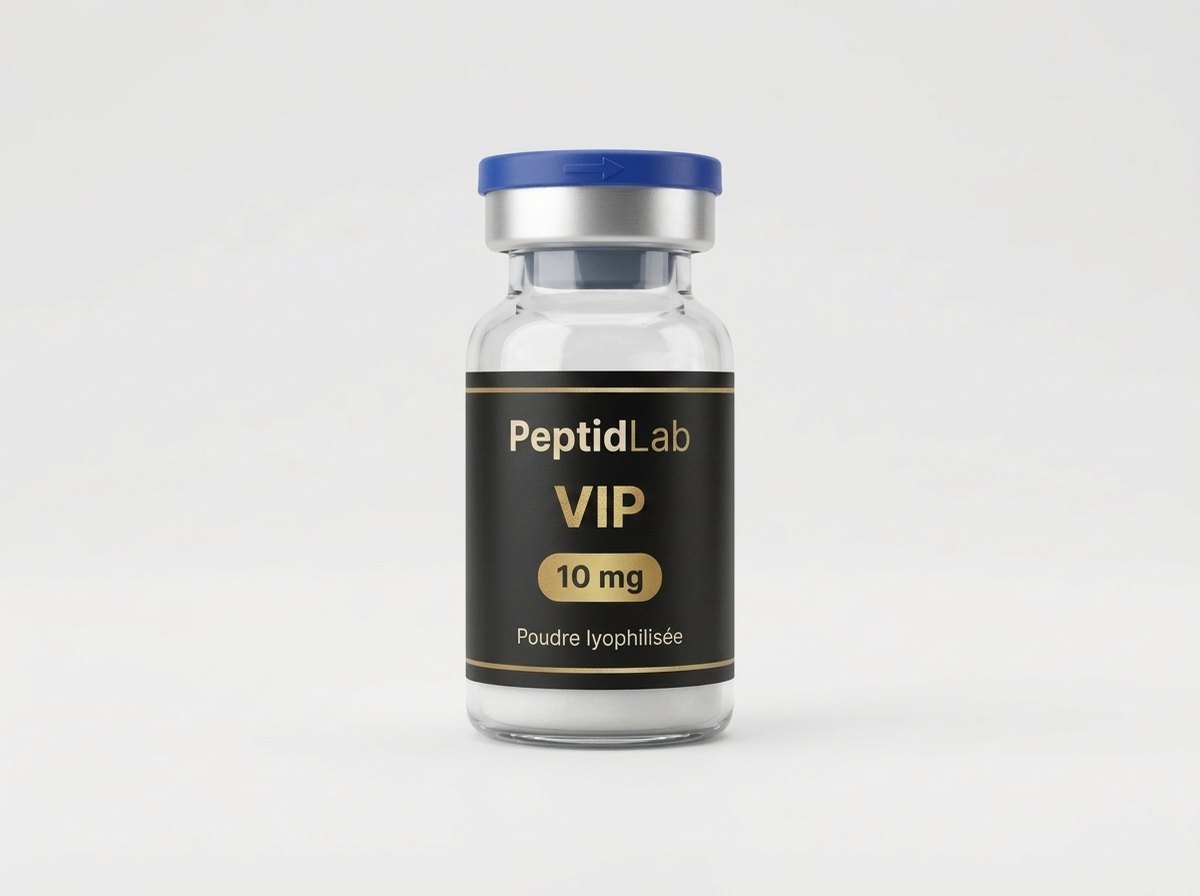
In 1970, Sami Said and Viktor Mutt isolated from pig intestine a peptide that dilates blood vessels. They named it "vasoactive intestinal peptide". It is a chain of 28 amino acids, from the same family as secretin, glucagon and PACAP.
A neuropeptide found everywhere
It soon became clear that VIP was not just a gut hormone. It is released by nerve endings in the digestive tract, the lungs, the blood vessels and the brain, where it plays a part in the body clock among other things. It acts on two main receptors, VPAC1 and VPAC2.
Roles studied
- Relaxation of the smooth muscle of blood vessels, airways and the digestive tract.
- Secretion of water and electrolytes by the gut: a rare tumour that produces excess VIP, the VIPoma, causes very heavy diarrhoea.
- Modulation of immunity, with mainly anti-inflammatory effects on the cells studied.
- Synchronisation of circadian rhythms in the suprachiasmatic nucleus.
Aviptadil: the medicine form
The synthetic form of VIP is called aviptadil. Combined with phentolamine, it is authorised in a few European countries for a urological indication. Aviptadil has also been studied by inhalation in pulmonary arterial hypertension and by infusion in severe respiratory failure, without leading to authorisation for these indications.
One difficulty comes up in all this work: VIP is broken down within one to two minutes in the blood, which complicates its use.
What it is not
The PeptidLab vial is not an aviptadil-based medicine. It is a laboratory reagent intended for research.
Fact sheet
- Last name
- VIP (vasoactive intestinal peptide)
- Structure
- 28 amino acids
- Family
- Secretin, glucagon and PACAP
- Receptor or target
- VPAC1 et VPAC2
- Published half-life
- About 1 to 2 minutes in the blood
- Medicine form
- Aviptadil
- Regulatory status
- Aviptadil authorised in a few European countries, combined with phentolamine
What the research says
Summary of published data, written by the PeptidLab team. It describes molecules studied in the laboratory or in clinical trials: nothing here is an indication for use.
1958Human studyAm J Med
Description of a syndrome combining a pancreatic tumour and refractory diarrhoea: it was later found to be caused by excess VIP.
1970DiscoveryScience
Said and Mutt isolate from the intestine a polypeptide with wide-ranging biological effects, including powerful dilation of blood vessels.
2003Pilot studyJ Clin Invest
In patients with pulmonary arterial hypertension, inhaled VIP improves several haemodynamic parameters.
2013ReviewAmino Acids
Overview of the immune functions of VIP, mainly anti-inflammatory in the models studied.
Safety: what studies report
- During the infusions studied, the adverse effects described are mainly flushing, a drop in blood pressure and diarrhoea.
Sources
Links to PubMed or to the original document. Articles in English.
- Verner JV, Morrison AB. Islet cell tumor and a syndrome of refractory watery diarrhea and hypokalemia. Am J Med, 1958. PubMed
- Said SI, Mutt V. Polypeptide with broad biological activity: isolation from small intestine. Science, 1970. PubMed
- Petkov V et al. Vasoactive intestinal peptide as a new drug for treatment of primary pulmonary hypertension. J Clin Invest, 2003. PubMed
- Delgado M, Ganea D. Vasoactive intestinal peptide: a neuropeptide with pleiotropic immune functions. Amino Acids, 2013. PubMed
Updated October 2026.
Frequently asked questions
Why "vasoactive"?
Because the peptide was first identified by its ability to dilate blood vessels.
What is a VIPoma?
A rare tumour that secretes excess VIP. It causes very heavy diarrhoea, which illustrates the effect of VIP on intestinal secretion.
Does VIP have a long half-life?
No. In the blood, it is broken down within one to two minutes.
This guide has an informative and scientific purpose. PeptidLab products are intended exclusively for laboratory research and are not intended for human or animal consumption.