Erythropoietin, or EPO, is known for stimulating red blood cell production. It also protects tissues under stress, such as the brain, the heart or the nerves. The problem: its effects on the blood, more red blood cells, risk of thrombosis and hypertension, prevent its use for this protection alone.
The innate repair receptor
The work of Anthony Cerami and Michael Brines showed that EPO acts on two different receptors. For red blood cells, a receptor made of two EPOR units. For tissue protection, a receptor combining EPOR and the common beta subunit, CD131: this is the "innate repair receptor", which appears in injured tissue.
ARA-290 is an 11-amino-acid peptide, designed from helix B of EPO. It activates the innate repair receptor without stimulating red blood cell production. Its international name is cibinetide.
What the trials show
- In patients with sarcoidosis and small nerve fibre loss, phase 2 trials described an improvement in neuropathic pain and in the density of corneal nerve fibres.
- In patients with type 2 diabetes, one trial reported improvements in some metabolic markers and in neuropathic symptoms.
- Animal models cover neuropathic pain, inflammation and wound healing.
What it is not
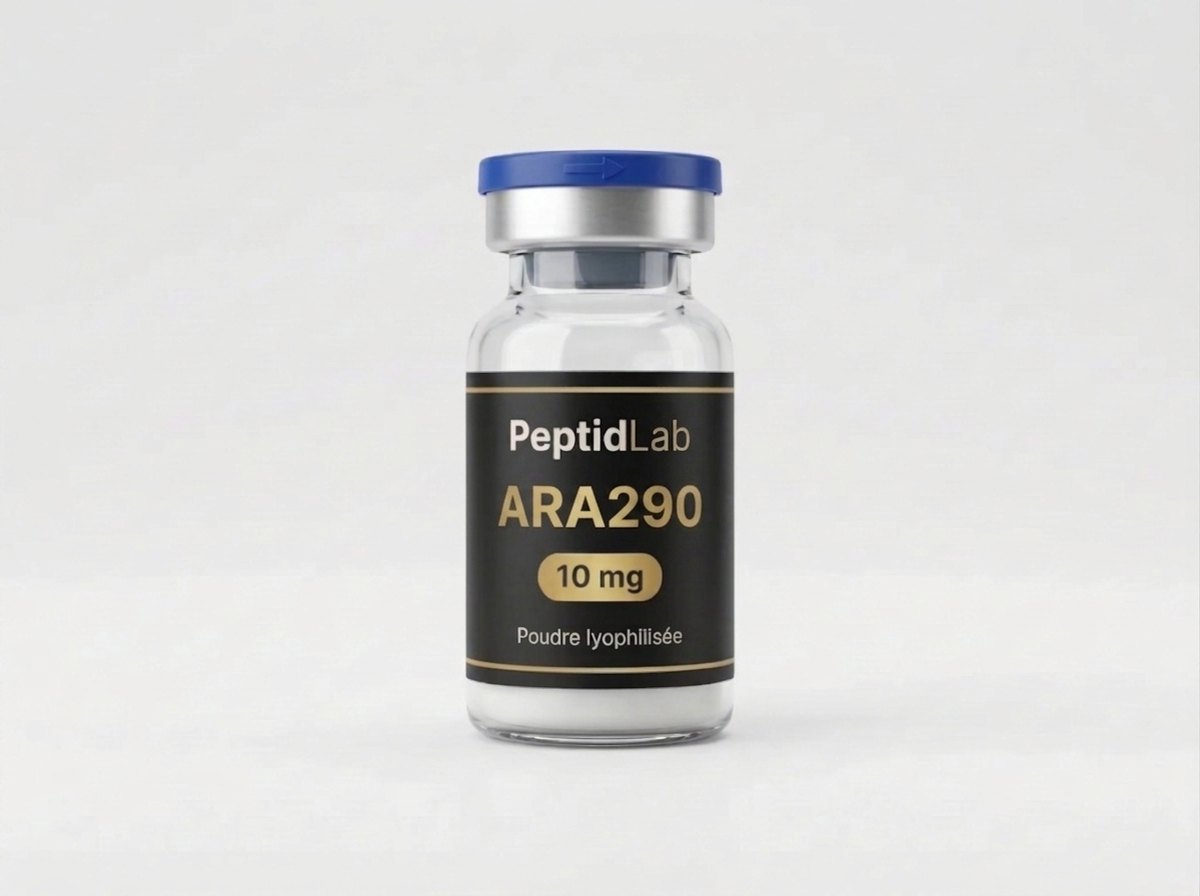
ARA-290 is not EPO, and studies do not describe any effect on red blood cell counts. It has no marketing authorisation. The PeptidLab vial is a laboratory reagent.
Fact sheet
- Last name
- ARA-290 (cibinetide, pHBSP)
- Structure
- 11 amino acids, designed from helix B of erythropoietin
- Molar mass
- About 1,257 g/mol
- Receptor or target
- Innate repair receptor (EPOR combined with the common beta subunit CD131)
- Effect on red blood cells
- None described in studies
- Regulatory status
- No marketing authorisation
What the research says
Summary of published data, written by the PeptidLab team. It describes molecules studied in the laboratory or in clinical trials: nothing here is an indication for use.
2008PreclinicalProc Natl Acad Sci USA
Peptides derived from the structure of EPO protect tissues in animals without stimulating red blood cell production.
2013Phase 2Mol Med
In patients with sarcoidosis and small nerve fibre loss, ARA-290 improves symptoms and increases corneal nerve fibre density.
2015Phase 2Mol Med
In patients with type 2 diabetes, improvement in some metabolic markers and in neuropathic symptoms.
2017Phase 2Invest Ophthalmol Vis Sci
Cibinetide increases the abundance of corneal nerve fibres in patients with sarcoidosis and neuropathic pain.
Safety: what studies report
- In published phase 2 trials, ARA-290 was well tolerated, with no described effect on haematocrit.
Sources
Links to PubMed or to the original document. Articles in English.
- Brines M et al. Nonerythropoietic, tissue-protective peptides derived from the tertiary structure of erythropoietin. Proc Natl Acad Sci USA, 2008. PubMed
- Dahan A et al. ARA 290 improves symptoms in patients with sarcoidosis-associated small nerve fiber loss and increases corneal nerve fiber density. Mol Med, 2013. PubMed
- Brines M et al. ARA 290, a nonerythropoietic peptide engineered from erythropoietin, improves metabolic control and neuropathic symptoms in patients with type 2 diabetes. Mol Med, 2015. PubMed
- Culver DA et al. Cibinetide Improves Corneal Nerve Fiber Abundance in Patients With Sarcoidosis-Associated Small Nerve Fiber Loss and Neuropathic Pain. Invest Ophthalmol Vis Sci, 2017. PubMed
Updated October 2026.
Frequently asked questions
Does ARA-290 increase red blood cells?
No. It was designed to avoid this effect of EPO, and the published trials do not describe it.
Why is it also called cibinetide?
It is its international nonproprietary name, the official name given to molecules in development.
Is it an authorised medicine?
No. It has been studied in phase 2 but has no marketing authorisation.
This guide has an informative and scientific purpose. PeptidLab products are intended exclusively for laboratory research and are not intended for human or animal consumption.