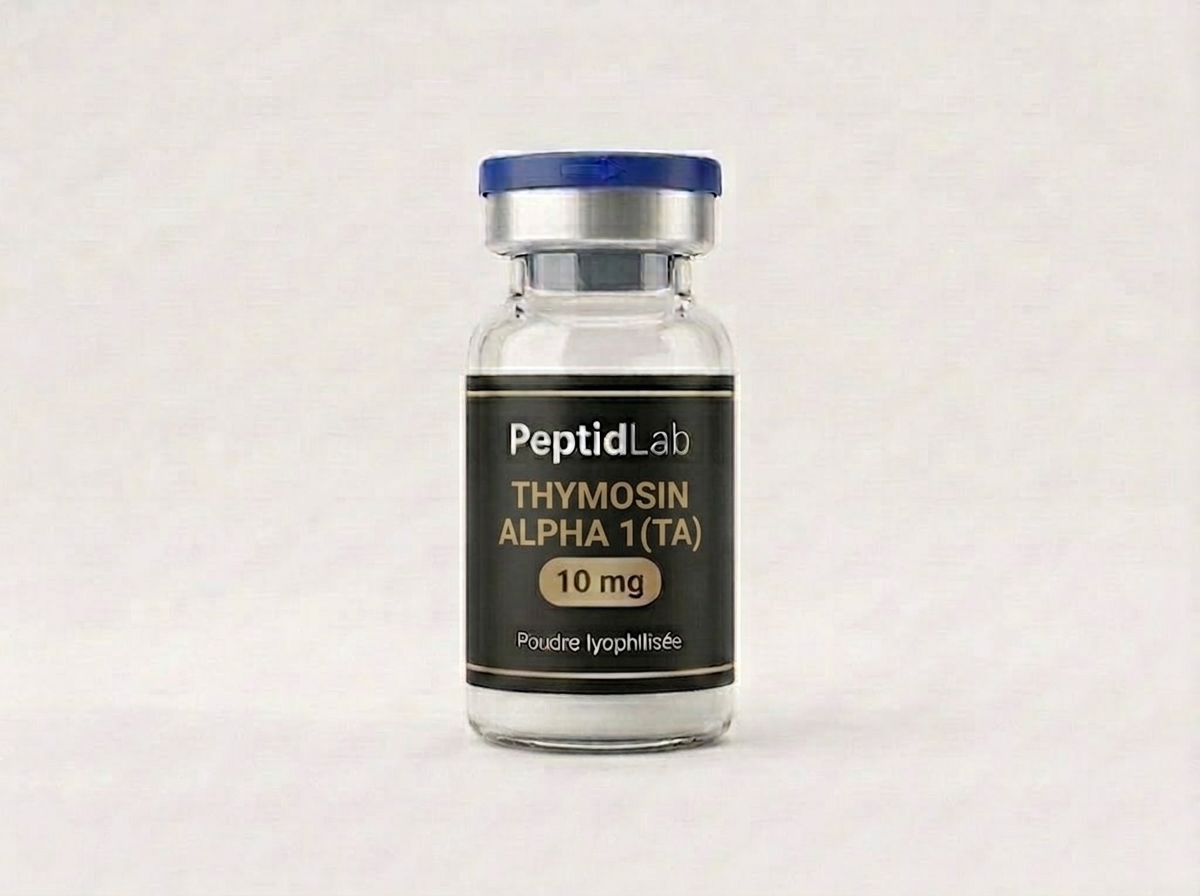
The thymosin alpha-1, or thymalfasin, is a 28-amino-acid peptide, first isolated from the thymus. It is studied for its effect on T lymphocytes: it does not "stimulate" the immune system in the vague sense of the word, it modulates responses already described in models of viral infection and immune deficiency. Zadaxin is the name of the medicine, where it is authorised. The catalogue vial is not that medicine.
The label specifies a fixed dose, not an escalation: 1,6 mg subcutaneously, twice a week, on fixed days. In the historical indication of chronic hepatitis B, the course is counted in months, not days. The catalogue page aligns 24 weeks on this rhythm, without inventing a higher step.
The calendar
- Weeks 1 to 4: 1.6 mg, twice a week.
- Weeks 5 to 24: the same dose, the same two days.
You do not go to 3 mg "to go faster", and you do not take the whole vial. 1.6 mg is already the label dose. The two days stay the same from one week to the next, for example Monday and Thursday, to keep the interval. The page: protocols.
Two vials, two volumes
The dose does not change. The volume changes with the concentration.
- 5 mg vial in 2 mL: 2.5 mg/mL. 1.6 mg is 0.64 mL, i.e. 64 U-100 units.
- 10 mg vial in 2 mL: 5 mg/mL. 1.6 mg is 0.32 mL, i.e. 32 units.
A 10 mg vial contains a little more than six doses of 1.6 mg. At two doses a week, that covers about three weeks, before syringe losses. The 5 mg vial covers a little more than three doses, so a week and a half. Note the reconstitution date: the solution is kept cold, not at room temperature.
Preparing without damaging the peptide
The solvent goes in along the wall, not in a jet onto the pellet. Roll the vial between your palms. Do not shake. Once the solution is clear, note the concentration: 2.5 or 5 mg/mL depending on the vial. The two weekly doses are given with a new syringe each time, and the site is rotated, abdomen, thigh or arm, as on the catalogue's other injectable product pages.
Frequently asked questions
TA1, thymalfasin and thymosin alpha-1: what are they?
Three names for the same 28-amino-acid peptide. The catalogue label shows thymosin alpha-1 and the vial mass.
Is the 10 mg vial a dose?
No. 10 mg is the powder. The schedule dose is 1.6 mg, twice a week. On a 10 mg vial reconstituted in 2 mL, that is 0.32 mL.
Should the dose be increased over the weeks?
No. The label and the product page keep 1.6 mg. Weeks 5 to 24 repeat the same dose; they do not increase it.
Zadaxin and this vial?
Zadaxin is the medicine, where it is authorised. The PeptidLab vial is a laboratory reagent, not that medicine.
Fact sheet
- Last name
- Thymosin alpha-1 (thymalfasin)
- Structure
- 28 amino acids, N-terminally acetylated
- Molar mass
- 3 108,3 g/mol
- N° CAS
- 62304-98-7
- Origin
- Isolated from the thymus (thymosin fraction 5) in 1977
- Regulatory status
- Authorised in several countries (Zadaxin); not authorised by the FDA or the European Medicines Agency
What the research says
Summary of published data, written by the PeptidLab team. It describes molecules studied in the laboratory or in clinical trials: nothing here is an indication for use.
1977DiscoveryProc Natl Acad Sci USA
Goldstein and colleagues isolate and sequence thymosin alpha-1, an immunologically active peptide from the thymus.
1998Randomised trialHepatology
In patients with chronic hepatitis B, thymalfasin increases the virological response rate compared with the control group.
2016ReviewVitam Horm
Overview of the described effects on immunity: T-cell maturation and modulation of responses to infection.
Safety: what studies report
- In published trials, thymalfasin is well tolerated; discomfort at the injection site is the most commonly reported effect.
Sources
Links to PubMed or to the original document. Articles in English.
- Goldstein AL et al. Thymosin alpha1: isolation and sequence analysis of an immunologically active thymic polypeptide. Proc Natl Acad Sci USA, 1977. PubMed
- Chien RN et al. Efficacy of thymosin alpha1 in patients with chronic hepatitis B: a randomized, controlled trial. Hepatology, 1998. PubMed
- King R, Tuthill C. Immune Modulation with Thymosin Alpha 1 Treatment. Vitam Horm, 2016. PubMed
Updated October 2026.
This guide has an informative and scientific purpose. PeptidLab products are intended exclusively for laboratory research and are not intended for human or animal consumption.