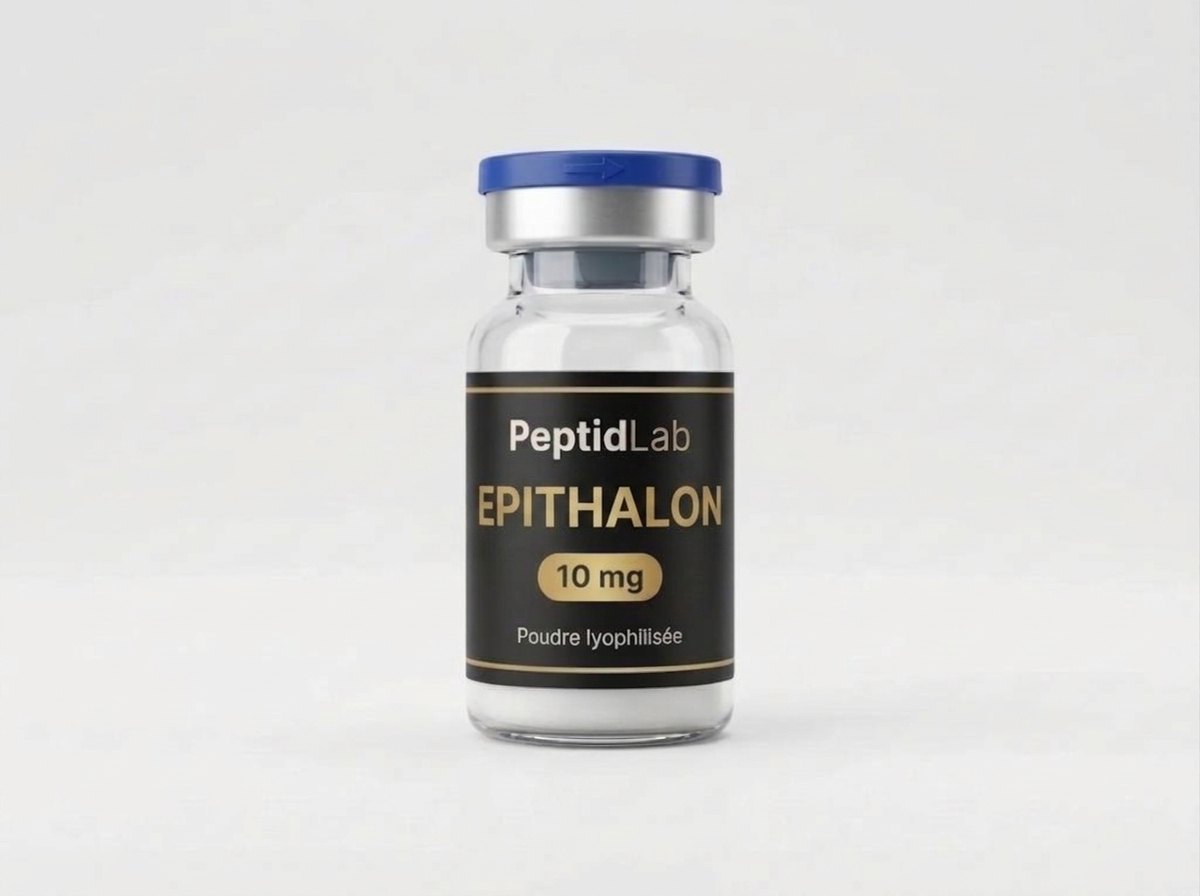
Epithalon, also spelled epitalon, is a synthetic tetrapeptide: alanine, glutamic acid, aspartic acid, glycine, hence its other name, AEDG. It was designed by Vladimir Khavinson's team in Saint Petersburg, based on the composition of epithalamin, a pineal gland extract studied in the USSR since the 1970s.
It belongs to what this team calls "peptide bioregulators": very short peptides thought to act on the expression of certain genes.
The telomerase lead
Telomeres are the protective ends of chromosomes. They shorten with each cell division, which eventually stops division. Telomerase is the enzyme that can lengthen them. In 2003, Khavinson's team described telomerase activation and telomere lengthening in cultured human cells exposed to Epithalon.
Melatonin and rhythms
The pineal gland produces melatonin, the day-night rhythm hormone, whose secretion declines with age. Several animal studies by the same group describe a melatonin rhythm closer to that of young animals after Epithalon administration, as well as a longer lifespan in some laboratory mice.
The limits
- The vast majority of the work comes from a single team and its collaborators.
- Independent replications, in other laboratories, remain rare.
- Human data are old, few in number and do not meet the standards of today's clinical trials.
What it is not
Epithalon is not an authorised medicine in the European Union, and no trial has shown that it slows ageing in humans. The PeptidLab vial is a laboratory reagent.
Fact sheet
- Last name
- Epithalon (epitalon, AEDG)
- Sequence
- Ala-Glu-Asp-Gly (4 amino acids)
- Molar mass
- 390,3 g/mol
- N° CAS
- 307297-39-8
- Origin
- Designed from epithalamin, a pineal gland extract
- Developer
- Saint Petersburg Institute of Bioregulation and Gerontology
- Regulatory status
- No marketing authorisation in the European Union
What the research says
Summary of published data, written by the PeptidLab team. It describes molecules studied in the laboratory or in clinical trials: nothing here is an indication for use.
2003PreclinicalBull Exp Biol Med
In cultured human somatic cells, Epithalon activates telomerase and lengthens telomeres.
2003PreclinicalBiogerontology
In female mice, Epithalon administration is associated with a longer lifespan and fewer spontaneous tumours.
Most studies come from the same team; independent replications remain rare.
Sources
Links to PubMed or to the original document. Articles in English.
- Khavinson VKh et al. Epithalon peptide induces telomerase activity and telomere elongation in human somatic cells. Bull Exp Biol Med, 2003. PubMed
- Anisimov VN et al. Effect of Epitalon on biomarkers of aging, life span and spontaneous tumor incidence in female Swiss-derived SHR mice. Biogerontology, 2003. PubMed
Updated October 2026.
Frequently asked questions
Are Epithalon and epithalamin the same thing?
No. Epithalamin is a pineal gland extract; Epithalon is a synthetic tetrapeptide designed from its composition.
Does Epithalon lengthen telomeres in humans?
This has not been demonstrated. The published results come mainly from cell cultures and animal studies.
Is it a medicine?
No. It has no marketing authorisation in the European Union.
This guide has an informative and scientific purpose. PeptidLab products are intended exclusively for laboratory research and are not intended for human or animal consumption.