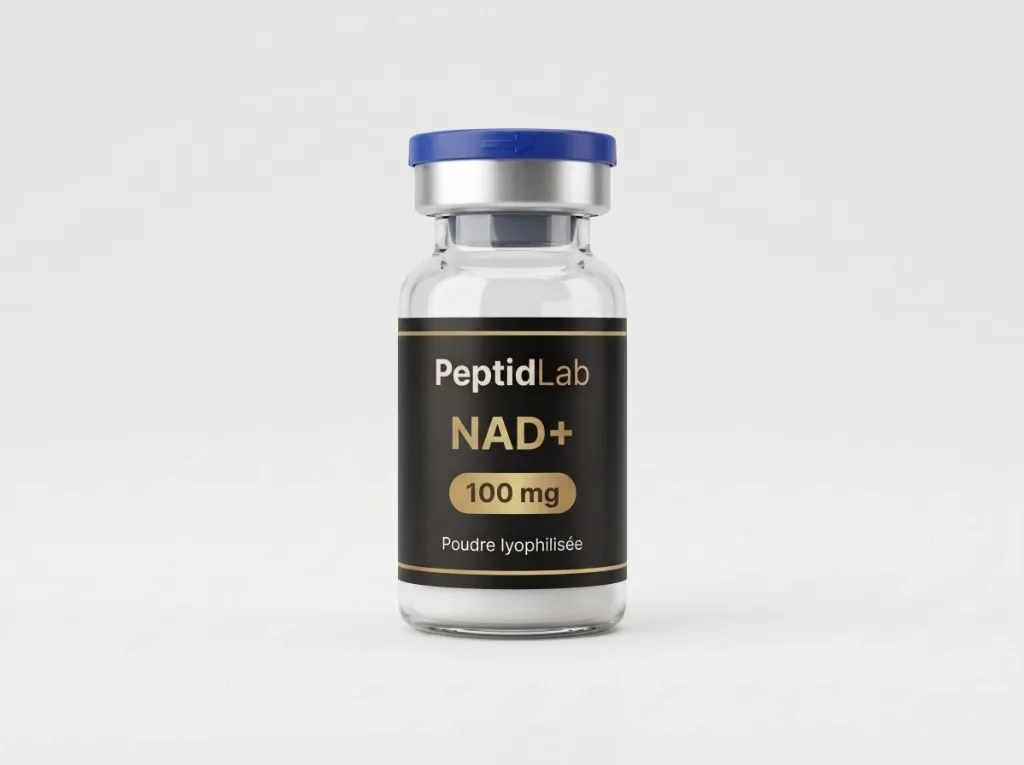
The NAD+ (nicotinamide adenine dinucleotide) is not a peptide. It's a cofactor : a small molecule without which energy metabolism enzymes cannot transfer electrons. We place it here next to peptides because laboratories often work on it using the same protocols — mitochondria, cellular aging, redox.
What is it for in the cell
Every time a cell “burns” glucose or fatty acids, it snatches electrons. NAD+ accepts them and becomes NADH. In the mitochondria, NADH transfers them to the respiratory chain, which produces ATP. Without NAD+, this cycle stops.
NAD+ also fuels other enzymes: sirtuins (regulation of gene expression, linked to energy status) and PARP (DNA repair). Consuming NAD+ to repair DNA means leaving less for metabolism: hence the interest of researchers in the “pool” of NAD+ in a tissue.
What the research studies
- Energy metabolism : glycolysis, Krebs cycle, oxidative phosphorylation.
- Cellular ageing : several studies describe a decline in NAD+ with age, in certain tissues.
- Sirtuins : these enzymes only work in the presence of NAD+.
- Genotoxic stress : PARPs consume NAD+ to signal DNA breakage.
Much of this literature is preclinical (cells, mice). Oral precursors (NMN, NR) are being tested in humans; Lyophilized laboratory NAD+ is not a food supplement, and we do not infer any health benefits from it.
Peptide or cofactor: why the distinction matters
A peptide is a chain of amino acids. NAD+ is a dinucleotide (nicotinamide + adenine). We do not reconstitute it to “mimic a hormone”: we use it as a biochemistry reagent. The vial 100 mg is intended exclusively for research.
For mitochondrial metabolism on the peptide side, see the MOTS-c and the storage of lyophilisates.
Fact sheet
- Last name
- Nicotinamide adenine dinucleotide (oxidised form)
- Formula
- C21H27N7O14P2
- Molar mass
- 663,4 g/mol
- N° CAS
- 53-84-9
- Nature
- Coenzyme, not a peptide
- Precursors studied
- Nicotinamide riboside (NR), nicotinamide mononucleotide (NMN), nicotinamide
What the research says
Summary of published data, written by the PeptidLab team. It describes molecules studied in the laboratory or in clinical trials: nothing here is an indication for use.
2015ReviewScience
NAD+ levels fall with age in several tissues; this decline is being studied as a factor in ageing and metabolic disease.
2018Randomised trialNat Commun
In middle-aged and older adults, nicotinamide riboside is well tolerated and raises blood NAD+.
2018ReviewCell Metab
Overview of animal data on molecules that raise NAD+: metabolic effects are clear in animals, more modest in humans.
2021Randomised trialScience
In 25 prediabetic women, NMN for 10 weeks improves muscle insulin sensitivity.
Safety: what studies report
- In short-term trials, oral NAD+ precursors (NR, NMN) were well tolerated. NAD+ infusions have been little studied in controlled trials.
Sources
Links to PubMed or to the original document. Articles in English.
- Verdin E. NAD+ in aging, metabolism, and neurodegeneration. Science, 2015. PubMed
- Martens CR et al. Chronic nicotinamide riboside supplementation is well-tolerated and elevates NAD+ in healthy middle-aged and older adults. Nat Commun, 2018. PubMed
- Rajman L, Chwalek K, Sinclair DA. Therapeutic Potential of NAD-Boosting Molecules: The In Vivo Evidence. Cell Metab, 2018. PubMed
- Yoshino M et al. Nicotinamide mononucleotide increases muscle insulin sensitivity in prediabetic women. Science, 2021. PubMed
Updated October 2026.
Frequently asked questions
Is NAD+ a peptide?
No. It is a dinucleotide, a metabolic cofactor. It is sold here in lyophilized vials for the laboratory, in the same way as research peptides.
NAD+ or NADH?
NAD+ is the oxidized form, NADH the reduced form. The cell continually converts them. Research on the “NAD pool” is mainly interested in NAD+.
Does NAD+ reverse aging?
No. NAD+ levels decline with age in several tissues, and sirtuins depend on them: these are avenues of research, not proof of an anti-aging effect in humans.
This guide has an informative and scientific purpose. PeptidLab products are intended exclusively for laboratory research and are not intended for human or animal consumption.