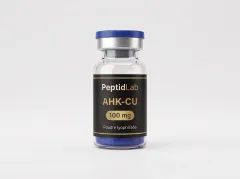
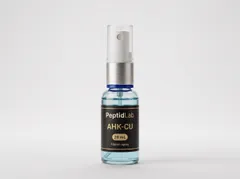
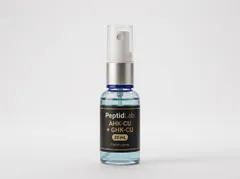
AHK-Cu is a tripeptide, alanine, histidine and lysine, bound to a copper ion. It belongs to the same family as GHK-Cu: in both cases, it is the histidine-lysine sequence that holds the copper and gives it its blue colour.
AHK-Cu ou GHK-Cu
The only structural difference is the first amino acid: an alanine instead of a glycine. That is enough for the two molecules to be studied separately. GHK-Cu is natural, present in human plasma, and has been studied extensively on skin. AHK-Cu is synthetic, and research has focused mainly on its effect on hair.
What the studies show
The most cited study, published in 2007, tested AHK-Cu on human hair follicles kept in culture and on cells from the dermal papilla, the structure that drives hair growth. The peptide lengthened the cultured follicles, stimulated the multiplication of papilla cells and reduced their programmed death.
- Published data are scarce and come mainly from laboratory experiments.
- No controlled clinical trial on hair growth has been published in a scientific journal.
- AHK-Cu is used as an ingredient in hair care products, applied to the scalp.
What it is not
It is not a treatment for hair loss and it has no marketing authorisation. PeptidLab's vial and sprays are research reagents.
Fact sheet
- Last name
- AHK-Cu, copper tripeptide
- Structure
- Alanine, histidine, lysine, bound to a copper (II) ion
- Molar mass of AHK
- 354,4 g/mol
- Family
- Copper tripeptides, like GHK-Cu
- Use
- Hair care ingredient
- Regulatory status
- No marketing authorisation
What the research says
Summary of published data, written by the PeptidLab team. It describes molecules studied in the laboratory or in clinical trials: nothing here is an indication for use.
2007PreclinicalArch Pharm Res
On human hair follicles in culture, AHK-Cu lengthens the follicles, stimulates the multiplication of dermal papilla cells and reduces their programmed death.
2018ReviewInt J Mol Sci
Review of work on the copper tripeptide family, including GHK-Cu, on skin and tissues.
No controlled clinical trial on hair growth has been published to date.
Sources
Links to PubMed or to the original document. Articles in English.
- Pyo HK et al. The effect of tripeptide-copper complex on human hair growth in vitro. Arch Pharm Res, 2007. PubMed
- Pickart L, Margolina A. Regenerative and Protective Actions of the GHK-Cu Peptide in the Light of the New Gene Data. Int J Mol Sci, 2018. PubMed
Updated October 2026.
Frequently asked questions
Are AHK-Cu and GHK-Cu interchangeable?
No. They are close, but their published data differ: GHK-Cu has mostly been studied on skin, AHK-Cu on the hair follicle.
Does AHK-Cu make hair grow back?
This has not been demonstrated in clinical trials. The published results come from follicles and cells in culture.
Why is the powder blue?
It is the colour of the complex formed by the peptide and the copper ion.
This guide has an informative and scientific purpose. PeptidLab products are intended exclusively for laboratory research and are not intended for human or animal consumption.