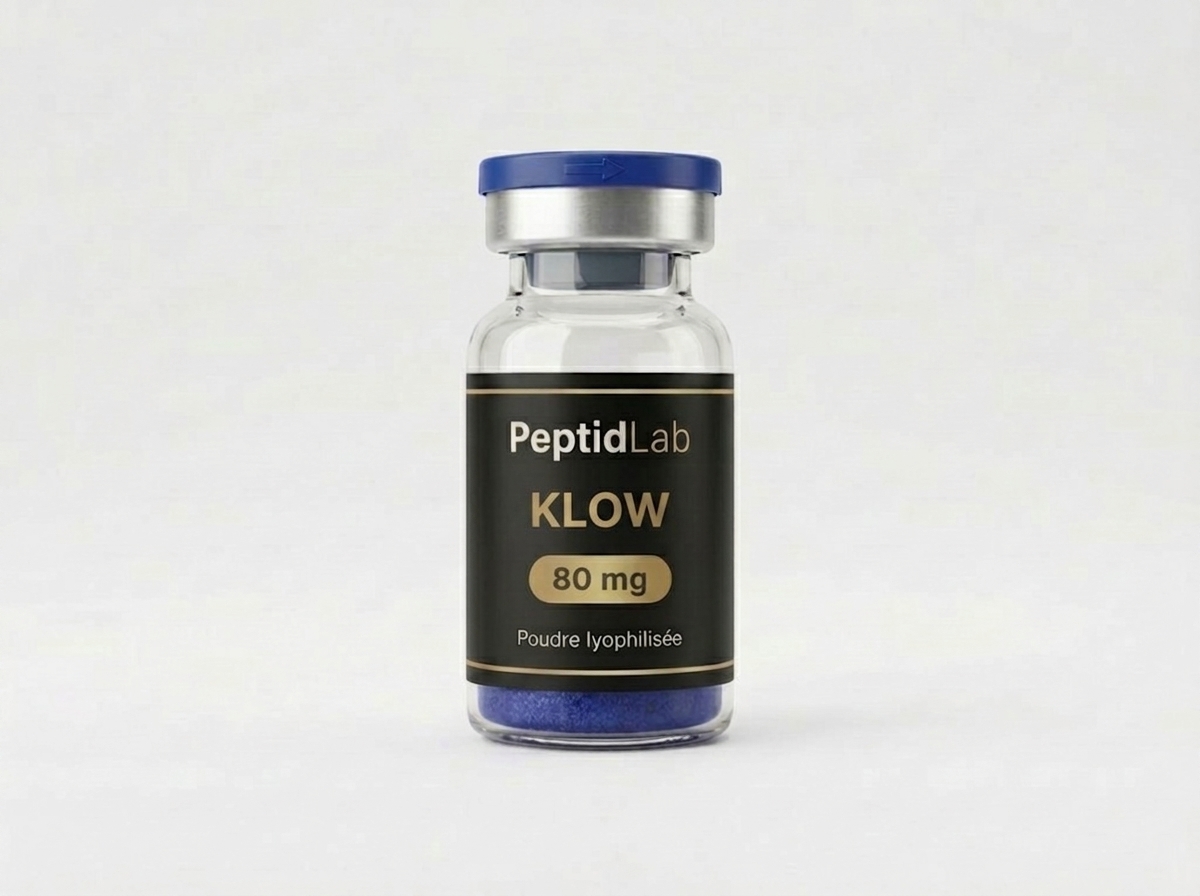
The Klow is not a single sequence. It is a lyophilized 80 mg blend. The formulation associated with this name generally combines GHK-Cu, of KPV, of BPC-157 and of TB-500. The ratio is not a universal convention: it is the one printed on your batch.
80 mg is not 80 mg of each
As with Glow 70 mg (GHK-Cu, BPC-157 and TB-500), the displayed mass is the total. A concentration calculation that treats 80 mg as if it were a single peptide goes wrong from the first dilution.
Before converting a volume into a mass of GHK-Cu or BPC-157, open the certificate and note the four masses. Without this ratio, the calculator can only give the concentration of the whole blend.
What each name is for
- GHK-Cu : copper tripeptide, literature mostly on skin and collagen.
- BPC-157 and TB-500 : peptides studied on tissue recovery, already in the catalogue separately.
- KPV : C-terminal fragment of α-MSH, studied on inflammation in preclinical models.
The vial: Klow 80 mg. The guide BPC-157 and TB-500 details two of the four components.
Frequently asked questions
Klow and Glow, what is the difference?
The catalogue's Glow is a 70 mg blend with three components (GHK-Cu, BPC-157, TB-500). Klow generally adds KPV and shows 80 mg in total. Compare the certificates, not just the names.
Can the powder be coloured?
The copper in GHK-Cu often gives the lyophilizate a blue tint. A stable colour is not a defect; a clear change after reconstitution is noted in the lab notebook.
Fact sheet
- Usual composition
- GHK-Cu, KPV, BPC-157 et TB-500
- KPV
- Lys-Pro-Val tripeptide, C-terminal fragment of α-MSH
- Molar mass of KPV
- 342,4 g/mol
- Regulatory status
- No marketing authorisation
What the research says
Summary of published data, written by the PeptidLab team. It describes molecules studied in the laboratory or in clinical trials: nothing here is an indication for use.
2008PreclinicalGastroenterology
KPV, carried into intestinal cells by the PepT1 transporter, reduces colon inflammation in mice.
2018ReviewInt J Mol Sci
Overview of the described actions of GHK-Cu on the skin and wound healing, based on laboratory data.
2016ReviewCurr Neuropharmacol
Overview of the work on BPC-157, almost all carried out in rodents.
No study has evaluated this blend as such: the published data concern each component taken separately.
Sources
Links to PubMed or to the original document. Articles in English.
- Dalmasso G et al. PepT1-mediated tripeptide KPV uptake reduces intestinal inflammation. Gastroenterology, 2008. PubMed
- Pickart L, Margolina A. Regenerative and Protective Actions of the GHK-Cu Peptide in the Light of the New Gene Data. Int J Mol Sci, 2018. PubMed
- Sikiric P et al. Brain-gut Axis and Pentadecapeptide BPC 157: Theoretical and Practical Implications. Curr Neuropharmacol, 2016. PubMed
Updated October 2026.
This guide has an informative and scientific purpose. PeptidLab products are intended exclusively for laboratory research and are not intended for human or animal consumption.