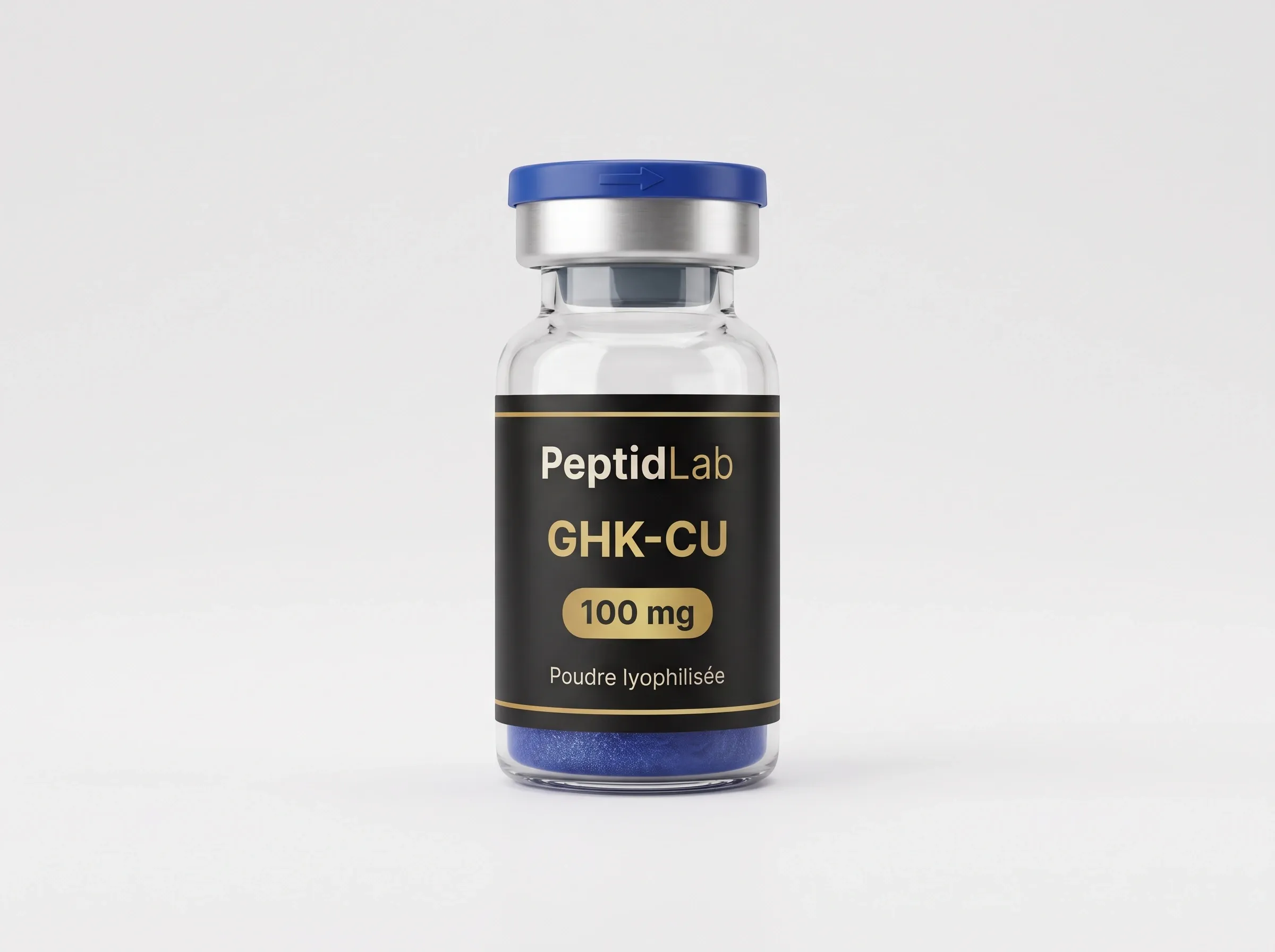
The GHK-Cu is one of the most studied peptides in scientific cosmetics and wound healing. Behind this name hides a very simple molecule: three amino acids and a copper atom.
A discovery from 1973
The GHK peptide was identified in 1973 by the American researcher Loren Pickart, in human plasma. He observed that a fraction of plasma from young subjects modified the activity of liver cells from older subjects, and isolated the peptide responsible.
A very simple structure
GHK designates the sequence of three amino acids: glycine, histidine and lysine. This tripeptide has a strong affinity for copper: it binds to a copper ion to form GHK-Cu, the most studied form. It is this copper that gives the powder its blue color.
GHK is naturally present in plasma, saliva and urine, and its concentration decreases with age.
What the research studies
- Wound healing : repair of the skin and tissues.
- Skin matrix : synthesis of collagen and glycosaminoglycans.
- Cell protection : antioxidant and anti-inflammatory properties.
- Gene expression : studies suggest an influence on the activity of many genes involved in tissue repair.
From laboratory to cosmetics
“Copper peptides” are present in many skin care products today. In the laboratory, GHK-Cu is used in the form of a more stable freeze-dried powder, redissolved at the time of use.
Choose and store your GHK-Cu wisely
- A powder of homogeneous blue.
- A certificate of analysis with HPLC purity and identity confirmation by mass spectrometry.
- Storage in the refrigerator and away from light.
GHK-Cu is also one of the three components of Glow blend, alongside the BPC-157 and the TB-500.
Fact sheet
- Last name
- GHK-Cu, copper tripeptide
- Structure
- Glycine, histidine, lysine, bound to a copper(II) ion
- Molar mass of GHK
- 340,4 g/mol
- Discovery
- 1973, in human plasma (Loren Pickart)
- Cosmetic name (INCI)
- Copper tripeptide-1
- Regulatory status
- Cosmetic ingredient; no authorised medicine
What the research says
Summary of published data, written by the PeptidLab team. It describes molecules studied in the laboratory or in clinical trials: nothing here is an indication for use.
1973DiscoveryNat New Biol
Pickart and Thaler isolate from human plasma a tripeptide that prolongs the survival of cultured liver cells.
1988PreclinicalFEBS Lett
The GHK-copper complex stimulates collagen synthesis by cultured fibroblasts.
2018ReviewInt J Mol Sci
Overview of the described actions of GHK-Cu: wound healing, skin remodelling and modulation of the expression of many genes, based on laboratory data.
Safety: what studies report
- Applied to the skin, GHK-Cu has been used in cosmetics for years. Its injection has not been evaluated in controlled human trials.
Sources
Links to PubMed or to the original document. Articles in English.
- Pickart L, Thaler MM. Tripeptide in human serum which prolongs survival of normal liver cells and stimulates growth in neoplastic liver. Nat New Biol, 1973. PubMed
- Maquart FX et al. Stimulation of collagen synthesis in fibroblast cultures by the tripeptide-copper complex glycyl-L-histidyl-L-lysine-Cu2+. FEBS Lett, 1988. PubMed
- Pickart L, Margolina A. Regenerative and Protective Actions of the GHK-Cu Peptide in the Light of the New Gene Data. Int J Mol Sci, 2018. PubMed
Updated October 2026.
Frequently asked questions
Why is GHK-Cu blue?
Because of the copper ion bound to the peptide. A uniform blue powder or solution is normal.
Is GHK-Cu used in cosmetics?
Yes, “copper peptides” are included in the composition of many serums and creams. Our freeze-dried vials are intended for laboratory research.
How to store GHK-Cu?
In the refrigerator, between 2 and 8°C, and especially away from light, to which it is particularly sensitive.
This guide has an informative and scientific purpose. PeptidLab products are intended exclusively for laboratory research and are not intended for human or animal consumption.