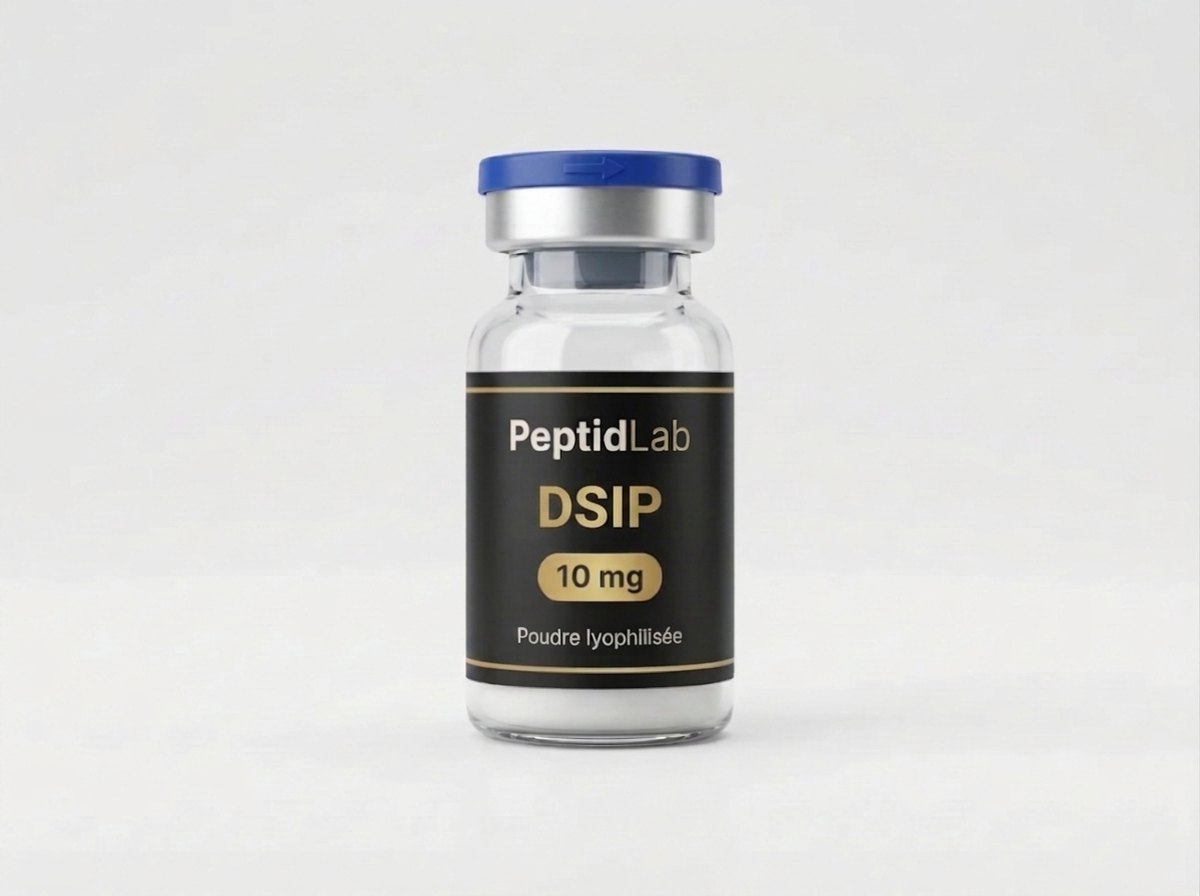
DSIP, short for "delta sleep-inducing peptide", is a nonapeptide: a chain of nine amino acids. It was isolated in 1977 in Basel by Guido Schoenenberger and Marcel Monnier, from the cerebral venous blood of rabbits put to sleep by electrical stimulation of the thalamus.
Injected into other rabbits, this extract increased the delta waves of the electroencephalogram, those of deep slow-wave sleep. Hence its name.
A peptide with no identified receptor
Nearly fifty years later, no specific DSIP receptor has been identified, and the gene that would encode it is not known with certainty. Yet the peptide has been detected in the brain, the pituitary gland, the gut and plasma. A 2006 review calls it "a still unresolved enigma".
What the studies measured
- In animals, an increase in slow-wave sleep in some models, but not all: results vary with species, dose and timing of the injection.
- Effects described on the stress response, body temperature and pain perception.
- In humans, a few small studies from the 1980s on insomnia, with modest and sometimes contradictory results.
Why the question remains open
DSIP's lifetime in the blood is very short, a matter of minutes, and it circulates partly bound to other molecules. With no known receptor, it is hard to link its effects to a precise mechanism. That is why DSIP remains mainly a tool for basic research on sleep regulation.
What it is not
DSIP is not a sleeping pill and has no marketing authorisation in Europe or the United States. The PeptidLab vial is a laboratory reagent.
Fact sheet
- Last name
- DSIP (delta sleep-inducing peptide)
- Sequence
- WAGGDASGE (9 amino acids)
- Molar mass
- 848,8 g/mol
- N° CAS
- 62568-57-4
- Discovery
- 1977, Schoenenberger and Monnier (Basel)
- Receptor or target
- Not identified to date
- Regulatory status
- No marketing authorisation
What the research says
Summary of published data, written by the PeptidLab team. It describes molecules studied in the laboratory or in clinical trials: nothing here is an indication for use.
1977DiscoveryProc Natl Acad Sci USA
Isolation and characterisation of the peptide from the blood of sleeping rabbits: it increases delta activity on the electroencephalogram.
1983Human studyNeuropsychobiology
Small human studies on sleep and other psychophysiological parameters, with modest results.
2006ReviewJ Neurochem
An overview of thirty years of research: effects described on sleep, stress and pain, but neither a receptor nor a gene identified with certainty.
Safety: what studies report
- The few human studies are old and small: they do not allow a safety profile to be established.
Sources
Links to PubMed or to the original document. Articles in English.
- Schoenenberger GA, Monnier M. Characterization of a delta-electroencephalogram (-sleep)-inducing peptide. Proc Natl Acad Sci USA, 1977. PubMed
- Schneider-Helmert D, Schoenenberger GA. Effects of DSIP in man. Multifunctional psychophysiological properties besides induction of natural sleep. Neuropsychobiology, 1983. PubMed
- Kovalzon VM, Strekalova TV. Delta sleep-inducing peptide (DSIP): a still unresolved riddle. J Neurochem, 2006. PubMed
Updated October 2026.
Frequently asked questions
Is DSIP a sleeping pill?
No. It was named after an effect observed in rabbits. No DSIP-based medicine is authorised in Europe or the United States.
Why do we speak of "delta" sleep?
Delta waves are the slow waves of the electroencephalogram, typical of deep sleep. It is their increase in rabbits that gave the peptide its name.
Is the DSIP receptor known?
No. This is one of the reasons why its mechanism is still debated.
This guide has an informative and scientific purpose. PeptidLab products are intended exclusively for laboratory research and are not intended for human or animal consumption.