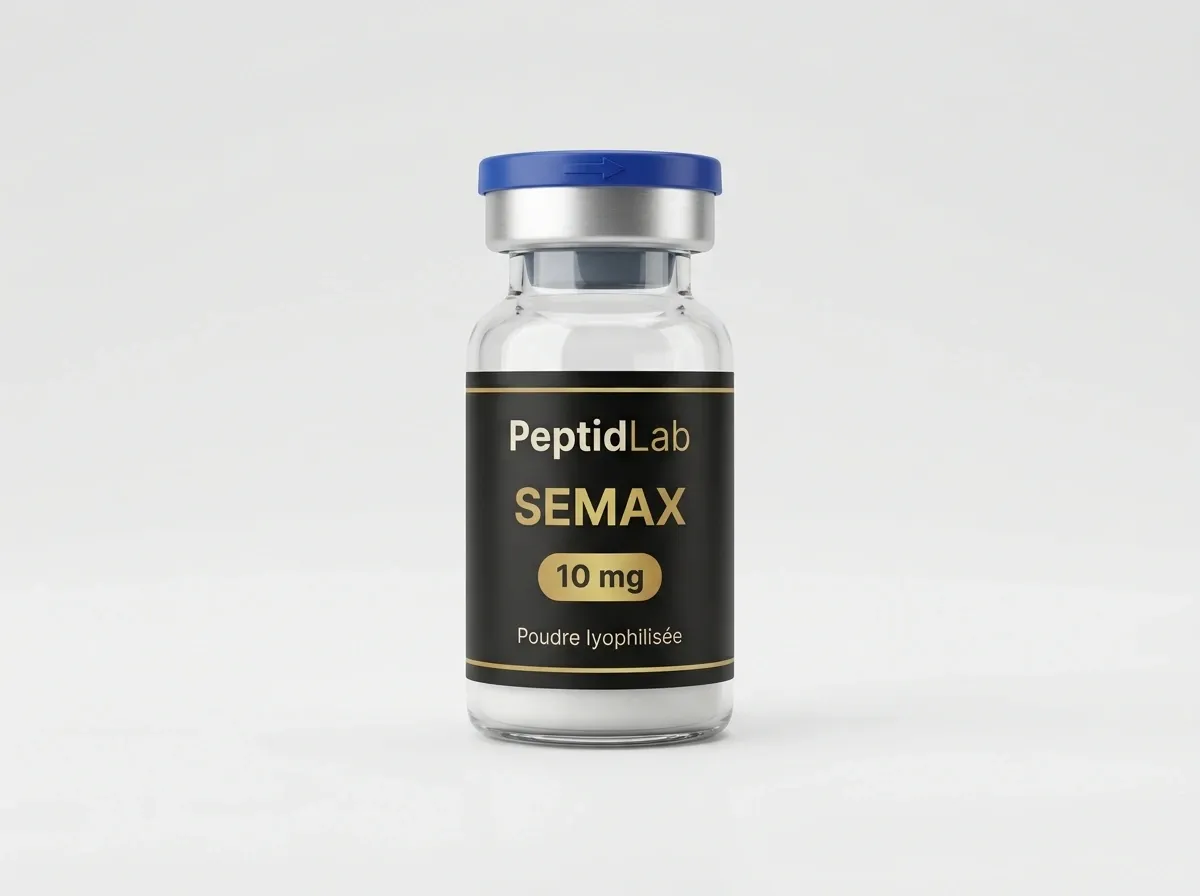
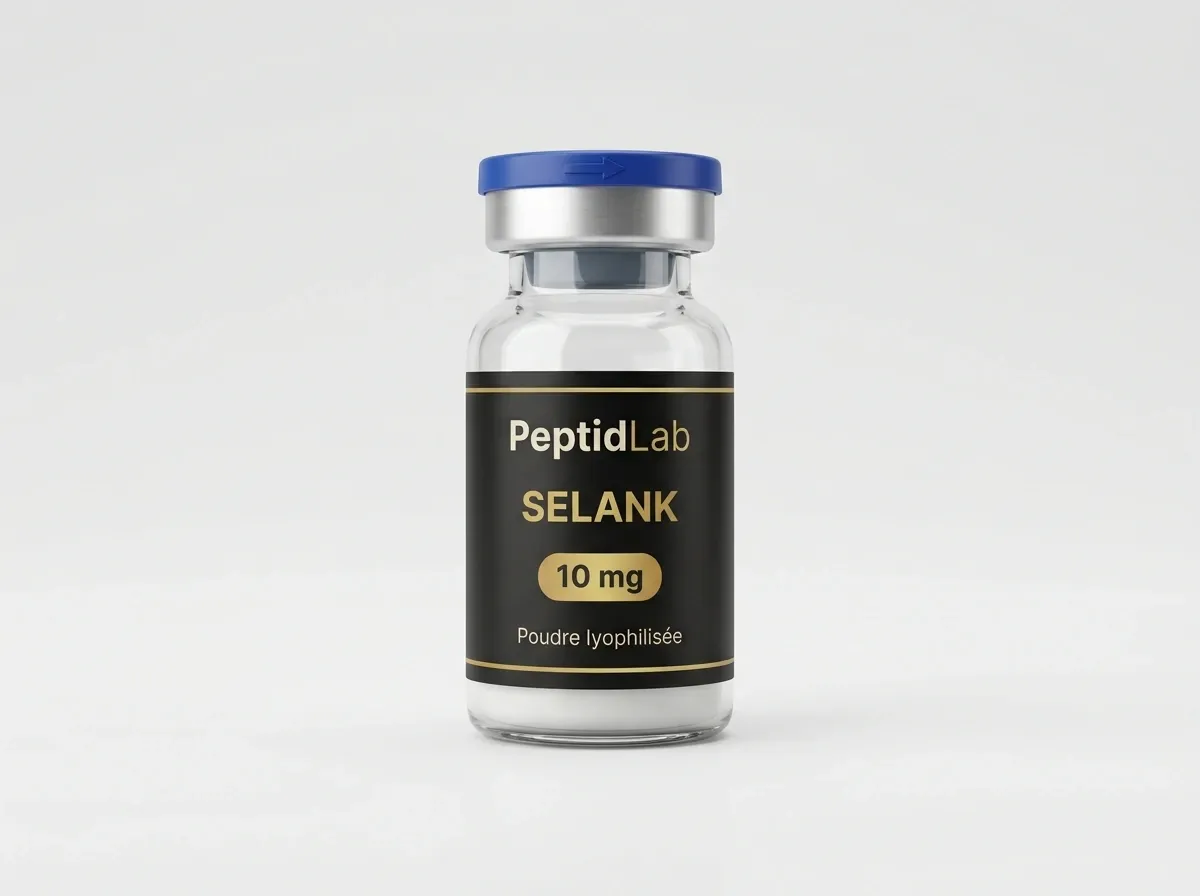
The Semax and the Selank are two peptides often presented together. Both were developed in Russia by the Institute of Molecular Genetics of the Academy of Sciences, both have seven amino acids, and both are stabilized by the same sequence: Pro-Gly-Pro. Their starting points and their lines of research are, however, different.
Semax
The Semax (sequence Met-Glu-His-Phe-Pro-Gly-Pro) takes up fragment 4-7 of ACTH, the adrenocorticotropic hormone, to which the Pro-Gly-Pro sequence is added. This extension protects it from too rapid degradation.
The work focuses on the neuroprotection, the cognitive functions and the expression of neurotrophic factors such as BDNF, a protein involved in the survival and plasticity of neurons.
The Selank
The Selank (sequence Thr-Lys-Pro-Arg-Pro-Gly-Pro) is an analogue of the tuftsin, a natural peptide of the immune system, also extended by Pro-Gly-Pro.
Research is interested in its influence on the stress response, anxiety and emotional regulation, particularly through the GABAergic system.
Semax or Selank: the differences
| Semax | Selank | |
|---|---|---|
| Origin | ACTH fragment | Tuftsin analogue |
| Sequence | MEHFPGP | TKPRPGP |
| Molar mass | 813,9 g/mol | 751,9 g/mol |
| Studied axis | Cognition, neuroprotection | Stress, anxiety |
Quality control
For such short peptides, mass spectrometry allows the identity of the molecule to be verified very precisely. Both also contain amino acids sensitive to oxidation (methionine for Semax): they can be stored in the cold, away from light. See our guides for read a certificate of analysis and store freeze-dried peptides.
Fact sheet
- Semax
- MEHFPGP heptapeptide: ACTH (4-7) fragment extended with Pro-Gly-Pro
- CAS number of Semax
- 80714-61-0
- Selank
- TKPRPGP heptapeptide: tuftsin extended with Pro-Gly-Pro
- CAS number of Selank
- 129954-34-3
- Origin
- Institute of Molecular Genetics of the Russian Academy of Sciences
- Regulatory status
- Registered as medicines in Russia; not authorised in the European Union
What the research says
Summary of published data, written by the PeptidLab team. It describes molecules studied in the laboratory or in clinical trials: nothing here is an indication for use.
2001PreclinicalBull Exp Biol Med
Selank inhibits the enzymes that break down enkephalins, a possible explanation for its anxiolytic effect in animals.
2006PreclinicalBrain Res
Semax increases the expression of BDNF and its receptor TrkB in the rat hippocampus.
2014PreclinicalBMC Genomics
After cerebral ischaemia in rats, Semax alters the expression of genes linked to immunity and blood vessels.
2016PreclinicalFront Pharmacol
Selank alters the expression of genes involved in GABAergic transmission in rats.
Safety: what studies report
- Clinical data come mainly from small Russian studies; few adverse effects are reported in them, but their methodological quality varies.
Sources
Links to PubMed or to the original document. Articles in English.
- Zozulya AA et al. The inhibitory effect of Selank on enkephalin-degrading enzymes as a possible mechanism of its anxiolytic activity. Bull Exp Biol Med, 2001. PubMed
- Dolotov OV et al. Semax, an analog of ACTH(4-10) with cognitive effects, regulates BDNF and trkB expression in the rat hippocampus. Brain Res, 2006. PubMed
- Medvedeva EV et al. The peptide semax affects the expression of genes related to the immune and vascular systems in rat brain focal ischemia: genome-wide transcriptional analysis. BMC Genomics, 2014. PubMed
- Volkova A et al. Selank Administration Affects the Expression of Some Genes Involved in GABAergic Neurotransmission. Front Pharmacol, 2016. PubMed
Updated October 2026.
Frequently asked questions
Are Semax and Selank nootropics?
They are often classified among “nootropic” peptides, because they are studied for their effects on cognitive functions (Semax) and on the stress response (Selank).
Are Semax and Selank authorized in France?
No. Both are registered as medicines in Russia, but have no authorization in France. Ours are intended exclusively for research.
This guide has an informative and scientific purpose. PeptidLab products are intended exclusively for laboratory research and are not intended for human or animal consumption.