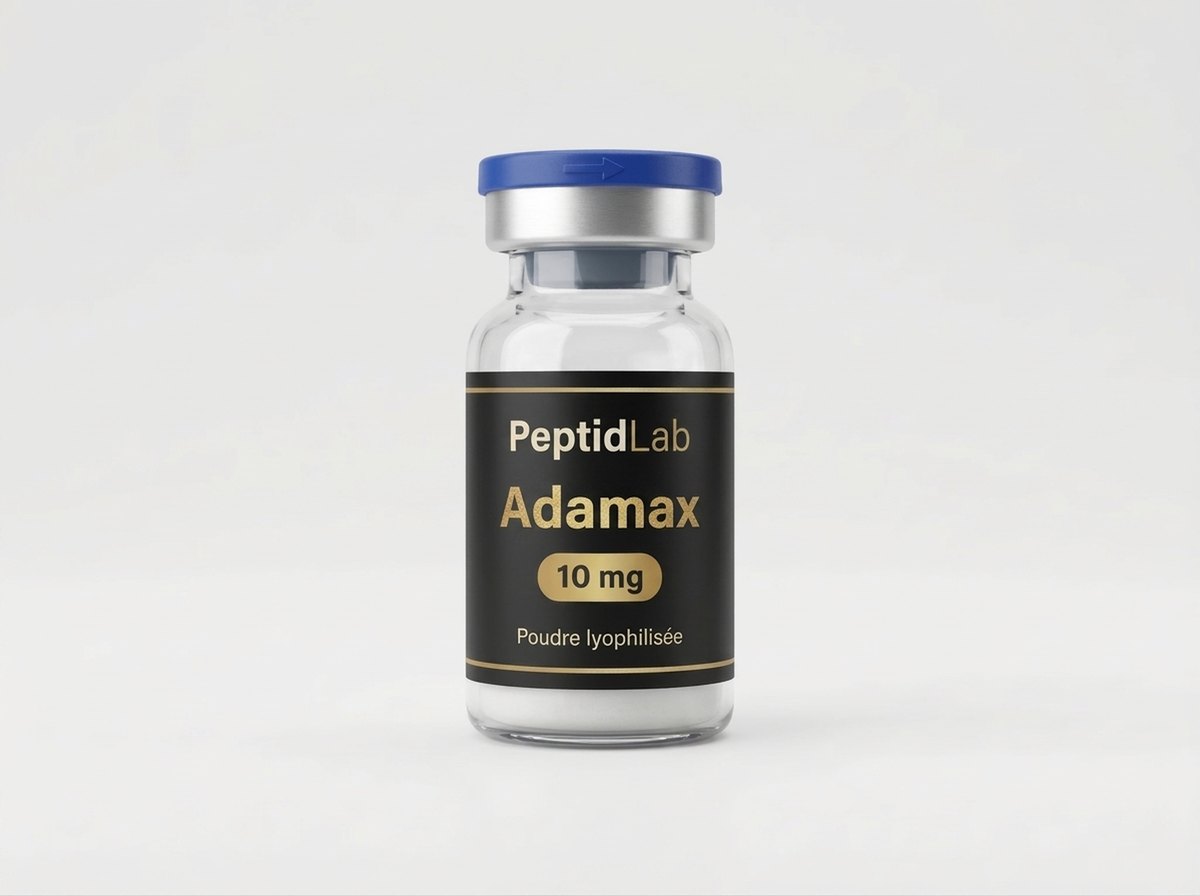
The Adamax starts from Semax. Semax is a fragment of ACTH, the hormone that stimulates the adrenal gland, modified to be studied on attention and the stress response. Adamax keeps this kinship and adds an adamantane group at the end of the chain. The idea, in chemistry work, is to make the peptide more stable, not to give it another indication. Closeness is not enough to copy a trial: there is no published clinical trial setting an Adamax dose in humans.
Semax, for its part, has its own page on this site, 300 to 800 µg per day over eight weeks. As long as no trial distinguishes Adamax, the Adamax page uses this titration, so that there is a measurable schedule instead of an empty page. This is not proof that the two molecules are equivalent. It is the catalogue's research schedule, aligned with the peptide it derives from. The guide Semax and Selank remains the reference for Semax itself.
The eight weeks
- Weeks 1 to 2: 300 µg per day.
- Weeks 3 to 4: 500 µg.
- Weeks 5 to 6: 600 µg.
- Weeks 7 to 8: 800 µg.
Once a day. You do not jump to 800 µg in the first week. The page: protocols.
The two vials
5 mg in 2 mL = 2.5 mg/mL, i.e. 2,500 µg/mL. 10 mg in 2 mL = 5 mg/mL, i.e. 5,000 µg/mL.
- At 2.5 mg/mL, 300 µg is 0.12 mL (12 units) and 800 µg is 0.32 mL (32 units).
- At 5 mg/mL, 300 µg is 0.06 mL (6 units) and 800 µg is 0.16 mL (16 units).
The 5 mg vial is often easier to measure in the first steps. The 10 mg vial lasts longer once the top step is reached: at 800 µg per day, 10 mg covers about a dozen doses. The two concentrations are not mixed in the same calculation.
Why adamantane
Adamantane is a very stable carbon cage used in chemistry to protect a molecule from degradation. On Adamax, it is grafted onto the peptide. This changes the mass, possibly the solubility and, perhaps, the time spent in the body. "Perhaps" is the right word: without a published pharmacokinetic trial, we do not know by how much. Hence the choice not to invent a dose lower or higher than the catalogue's Semax, and to keep the same eight weeks.
Frequently asked questions
Adamax and Semax, same schedule?
On this page, yes: 300 to 800 µg over eight weeks, because there is no trial specific to Adamax. This is not a demonstration that the two molecules are identical. Semax keeps its own page.
Is it a nootropic like Semax?
It is a Semax analogue with an adamantane group. The studied use of Semax does not transfer automatically. The schedule is for measuring a solution, not for promising an effect.
Why not use a lower dose, to be cautious?
The catalogue aligns Adamax with the Semax already published here, step by step, instead of inventing a third scale. The first step remains 300 µg, not 800.
Is the 10 mg vial the dose?
No. 10 mg is the powder. The daily dose is between 300 and 800 µg depending on the week.
Fact sheet
- Last name
- Adamax
- Nature
- Semax derivative carrying an adamantane group
- Published data
- Very limited: no published clinical study
- Regulatory status
- No marketing authorisation
What the research says
Summary of published data, written by the PeptidLab team. It describes molecules studied in the laboratory or in clinical trials: nothing here is an indication for use.
2006PreclinicalBrain Res
The available data mainly concern Semax, its parent molecule: in rats, it increases BDNF expression in the hippocampus.
Semax's properties do not automatically carry over to Adamax: the chemical modification changes the molecule.
Sources
Links to PubMed or to the original document. Articles in English.
- Dolotov OV et al. Semax, an analog of ACTH(4-10) with cognitive effects, regulates BDNF and trkB expression in the rat hippocampus. Brain Res, 2006. PubMed
Updated October 2026.
This guide has an informative and scientific purpose. PeptidLab products are intended exclusively for laboratory research and are not intended for human or animal consumption.