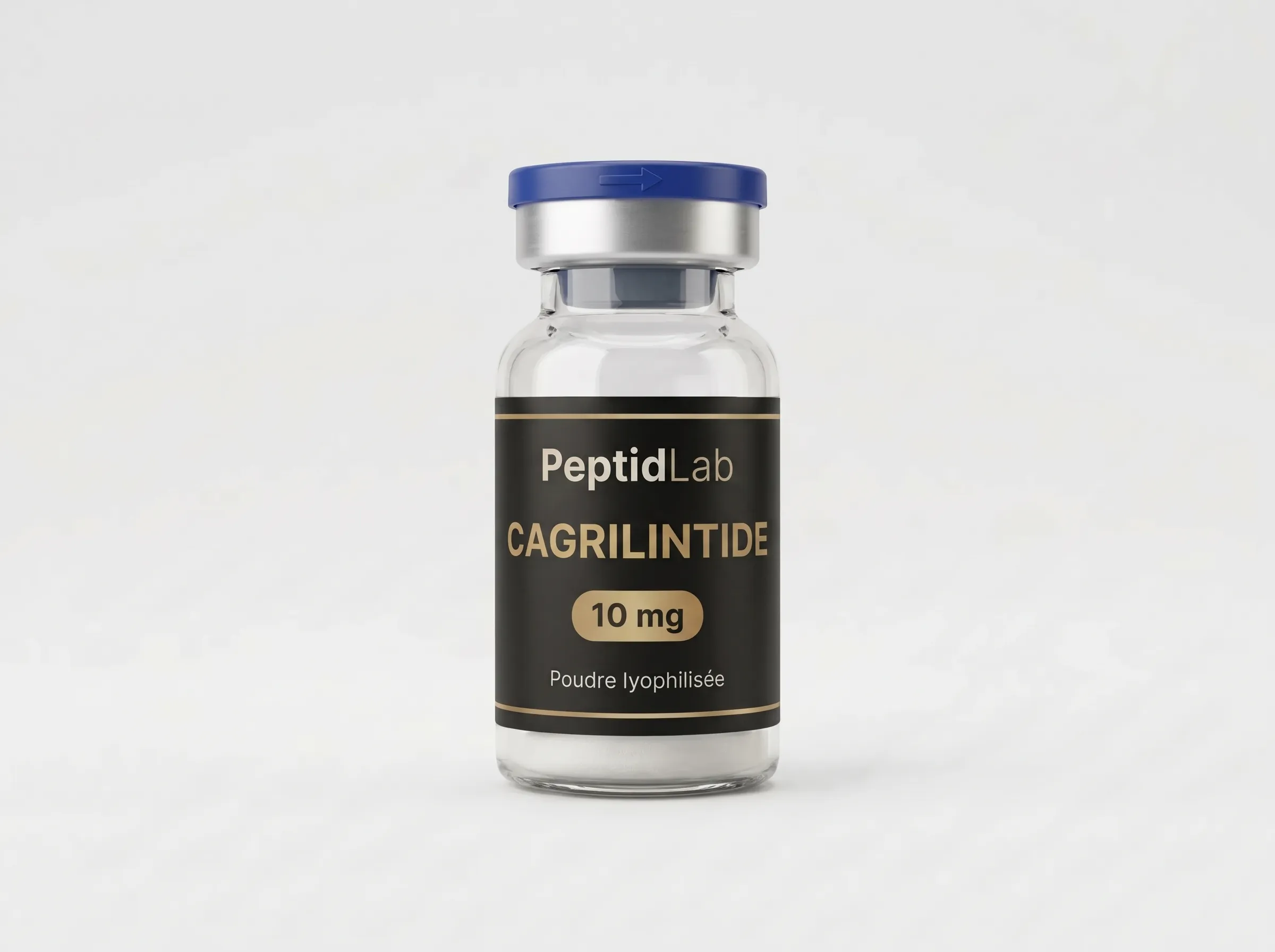
The cagrilintide does not belong to the GLP-1 family. It is an analogue of the amylin, hormone co-secreted with insulin by the beta cells of the pancreas. It is often placed alongside incretins because research studies them together — not because they activate the same receptor.
What is amylin used for?
After a meal, the pancreas releases insulin and amylin. Amylin contributes to the satiety and slows down the gastric emptying : the stomach empties less quickly, the satiety signal arrives sooner. The natural hormone is too unstable to be used as is in research. Cagrilintide takes up the mechanism, with a much longer duration of action.
How it works
The peptide binds to amylin receptors (calcitonin receptor family). It is neither the GLP-1 receptor, nor the GIP receptor, nor the glucagon receptor. Hence the interest in combined protocols: two hormones, two pathways, the same questioning on appetite and metabolism.
- Satiety : signal to the central nervous system, distinct from that of GLP-1.
- Gastric emptying : the meal stays longer in the stomach, on the models studied.
- Incretin supplement : the most cited program combines cagrilintide and semaglutide (“CagriSema”).
These results come from clinical trials and preclinical work on the analogue developed by the industry. They do not constitute no promise of results for a research peptide, let alone a therapeutic indication.
Cagrilintide and R3TA
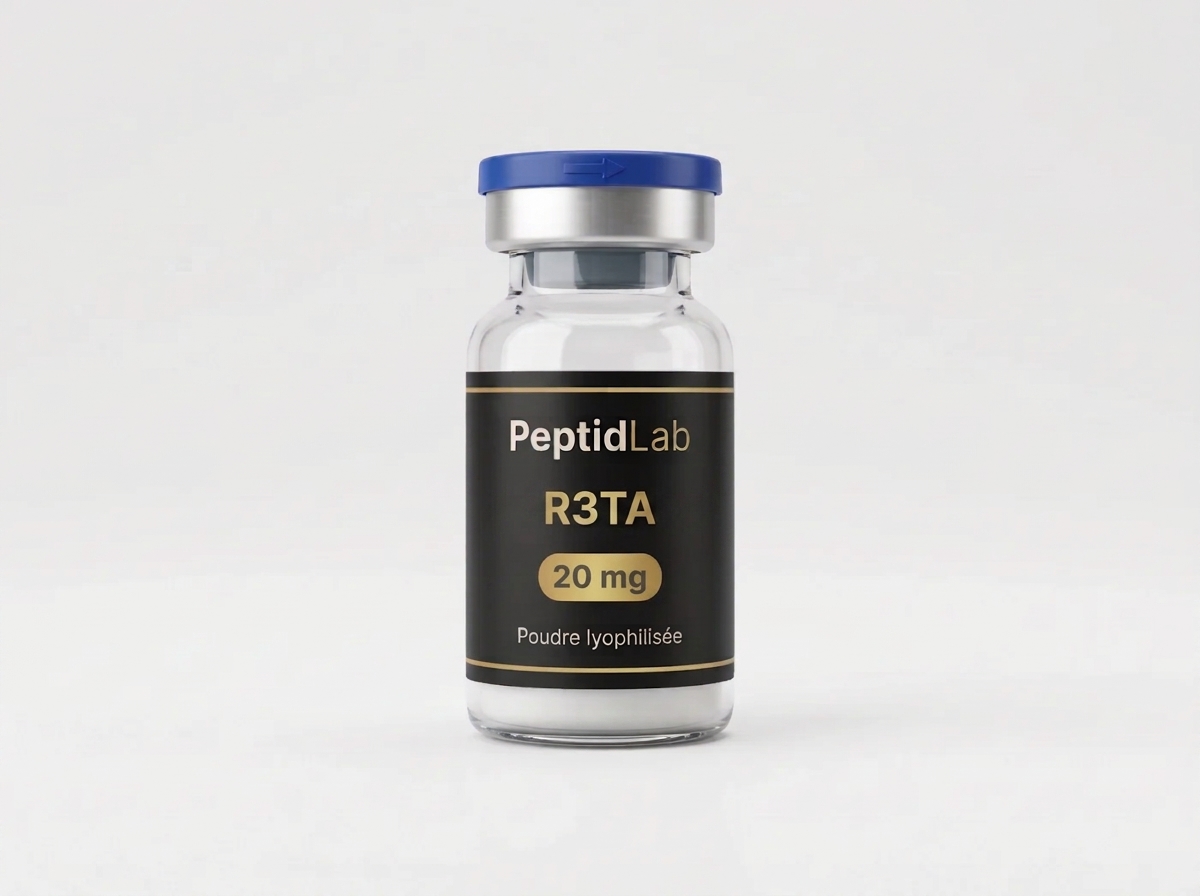
The R3TA activates GLP-1, GIP and glucagon. The cagrilintide mimics amylin. Bring them together in the 10 mg blend allows you to study both axes without multiplying the vials. There is no obligation to combine them: each molecule can also be controlled alone.
What it is not
It is not a “GLP-1 bis”, not a fat burner, not a weight loss protocol to follow. It's a laboratory reagent. See also our guide on peptides studied in metabolism and the storage of lyophilisates.
Fact sheet
- Last name
- Cagrilintide
- Development code
- NN9838
- Family
- Long-acting amylin analogue
- Receptor or target
- Amylin and calcitonin receptors
- Published half-life
- About 7 to 8 days
- Developer
- Novo Nordisk
- Regulatory status
- In clinical development (CagriSema combination), with no marketing authorisation
What the research says
Summary of published data, written by the PeptidLab team. It describes molecules studied in the laboratory or in clinical trials: nothing here is an indication for use.
2021Phase 2The Lancet
706 adults with overweight or obesity, 26 weeks. Up to 10.8% weight loss with 4.5 mg, versus 3.0% on placebo and 9.0% on liraglutide 3 mg.
2021Phase 1bThe Lancet
Combined with semaglutide 2.4 mg for 20 weeks: acceptable tolerability profile and greater weight loss than with semaglutide alone.
2023Phase 2The Lancet
In patients with type 2 diabetes, the CagriSema combination lowered weight much more than either molecule alone, and HbA1c at least as much as semaglutide alone.
2025Phase 3N Engl J Med
REDEFINE 1: in adults with obesity or overweight, the combination of cagrilintide 2.4 mg and semaglutide 2.4 mg led to an average weight loss of about 20% at 68 weeks.
Safety: what studies report
- The most common adverse effects are digestive (nausea, constipation, diarrhoea), as with GLP-1 analogues.
Sources
Links to PubMed or to the original document. Articles in English.
- Lau DCW et al. Once-weekly cagrilintide for weight management in people with overweight and obesity: a multicentre, randomised, double-blind, placebo-controlled and active-controlled, dose-finding phase 2 trial. The Lancet, 2021. PubMed
- Enebo LB et al. Safety, tolerability, pharmacokinetics, and pharmacodynamics of concomitant administration of multiple doses of cagrilintide with semaglutide 2·4 mg for weight management. The Lancet, 2021. PubMed
- Frias JP et al. Efficacy and safety of co-administered once-weekly cagrilintide 2·4 mg with once-weekly semaglutide 2·4 mg in type 2 diabetes. The Lancet, 2023. PubMed
- Garvey WT et al. Coadministered Cagrilintide and Semaglutide in Adults with Overweight or Obesity. N Engl J Med, 2025. PubMed
Updated October 2026.
Frequently asked questions
Is cagrilintide a GLP-1 analogue?
No. It mimics amylin, a pancreatic hormone. GLP-1 is an intestinal incretin. Both act on satiety, through different receptors.
Why is it sold with R3TA?
Because research protocols often combine incretins and amylin. The blend in a single vial avoids two reconstitutions. Each molecule also exists separately.
Is cagrilintide a medicine?
An amylin analogue is in clinical development (combination with semaglutide). PeptidLab vials are research peptides, without marketing authorization.
This guide has an informative and scientific purpose. PeptidLab products are intended exclusively for laboratory research and are not intended for human or animal consumption.