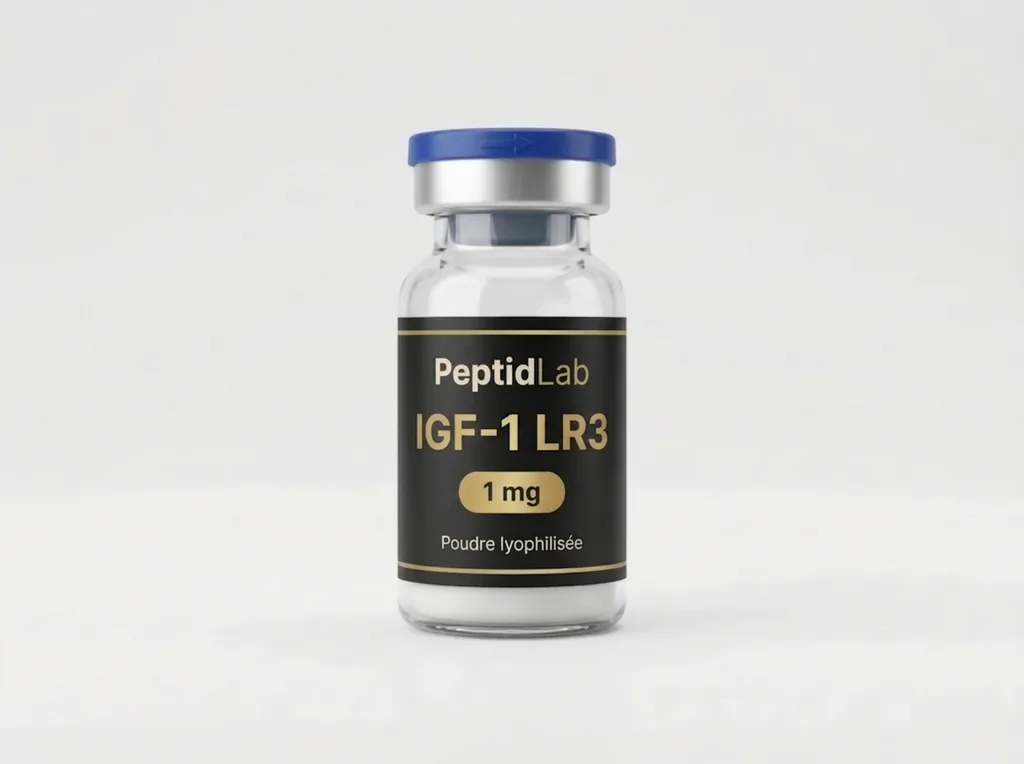
The IGF-1 (insulin-like growth factor 1) is a natural peptide, structurally close to insulin. The liver produces it mainly under the effect of growth hormone. The variant LR3 (Long Arg3) is a laboratory form, designed to remain available in solution for longer.
How it works
IGF-1 binds to its receptor (IGF-1R), a tyrosine kinase. This signal directs the cell towards the growth, the protein synthesis and, depending on the tissue, glucose metabolism. In the blood, most of the natural IGF-1 is stuck in complexes with transporter proteins (IGFBP): only a fraction circulates “free”.
The LR3 changes two things: one arginine in position 3 and a extension of 13 amino acids at the N-terminus. Desired result: less attachment to IGFBP, a molecule more available to the receptor in a culture medium or an experimental model.
What the research studies
- Cell cultures : proliferation, survival, differentiation.
- GH / IGF-1 axis : growth hormone acts largely via IGF-1.
- Metabolism : overlaps with insulin signaling, hence the caution of the protocols.
Mainstream literature often associates IGF-1 with bodybuilding. This is not the scope of this site: vial 0.1 mg is a reagent, with no dosage and no human use.
IGF-1 LR3, HGH, ipamorelin, tesamorelin
Four different floors:
- the ipamorelin mimics ghrelin and releases HGH;
- the tesamorelin mimics GHRH, same objective upstream;
- the HGH is the hormone itself;
- IGF-1 LR3 is a “downstream” mediator.
Axis detail in the guide HGH and tesamorelin. Conservation: guide lyophilized peptides.
Fact sheet
- Last name
- IGF-1 LR3 (Long Arg3 IGF-1)
- Structure
- 83 amino acids: IGF-1 with arginine at position 3 and a 13-amino-acid N-terminal extension
- Molar mass
- About 9,111 Da
- N° CAS
- 946870-92-4
- Special feature
- Greatly reduced binding to carrier proteins (IGFBPs), hence prolonged activity in vitro
- Main use
- Cell culture medium supplement in bioproduction
- Anti-doping status (WADA)
- Prohibited at all times (class S2)
What the research says
Summary of published data, written by the PeptidLab team. It describes molecules studied in the laboratory or in clinical trials: nothing here is an indication for use.
1992PreclinicalJ Mol Endocrinol
LR3-type analogues bind much less to IGFBPs, which greatly increases their biological potency in culture.
2005ApprovalFDA
Mecasermin (recombinant human IGF-1, Increlex) is authorised for severe primary IGF-1 deficiency; IGF-1 LR3, on the other hand, is not a medicine.
Safety: what studies report
- The best-documented adverse effect of recombinant IGF-1 (mecasermin) is hypoglycaemia. IGF-1 LR3 has not been evaluated in human trials.
Sources
Links to PubMed or to the original document. Articles in English.
- Francis GL et al. Novel recombinant fusion protein analogues of insulin-like growth factor (IGF)-I indicate the relative importance of IGF-binding protein and receptor binding for enhanced biological potency. J Mol Endocrinol, 1992. PubMed
- Rosenbloom AL. Mecasermin (recombinant human insulin-like growth factor I). Adv Ther, 2009. PubMed
Updated October 2026.
Frequently asked questions
Why "LR3"?
Long: an extension of 13 amino acids at the N-terminal. R3: An arginine replaces glutamic acid at position 3. Both of these changes reduce binding to transporter proteins (IGFBP).
Is IGF-1 LR3 growth hormone?
No. HGH is secreted by the pituitary gland. IGF-1 is one of its mediators, produced in particular by the liver. The LR3 form is a laboratory variant of this IGF-1.
Why a 0.1 mg vial?
IGF-1 LR3 is used in research in very small quantities. The 0.1 mg format corresponds to this scale, not a “human dosage”.
This guide has an informative and scientific purpose. PeptidLab products are intended exclusively for laboratory research and are not intended for human or animal consumption.