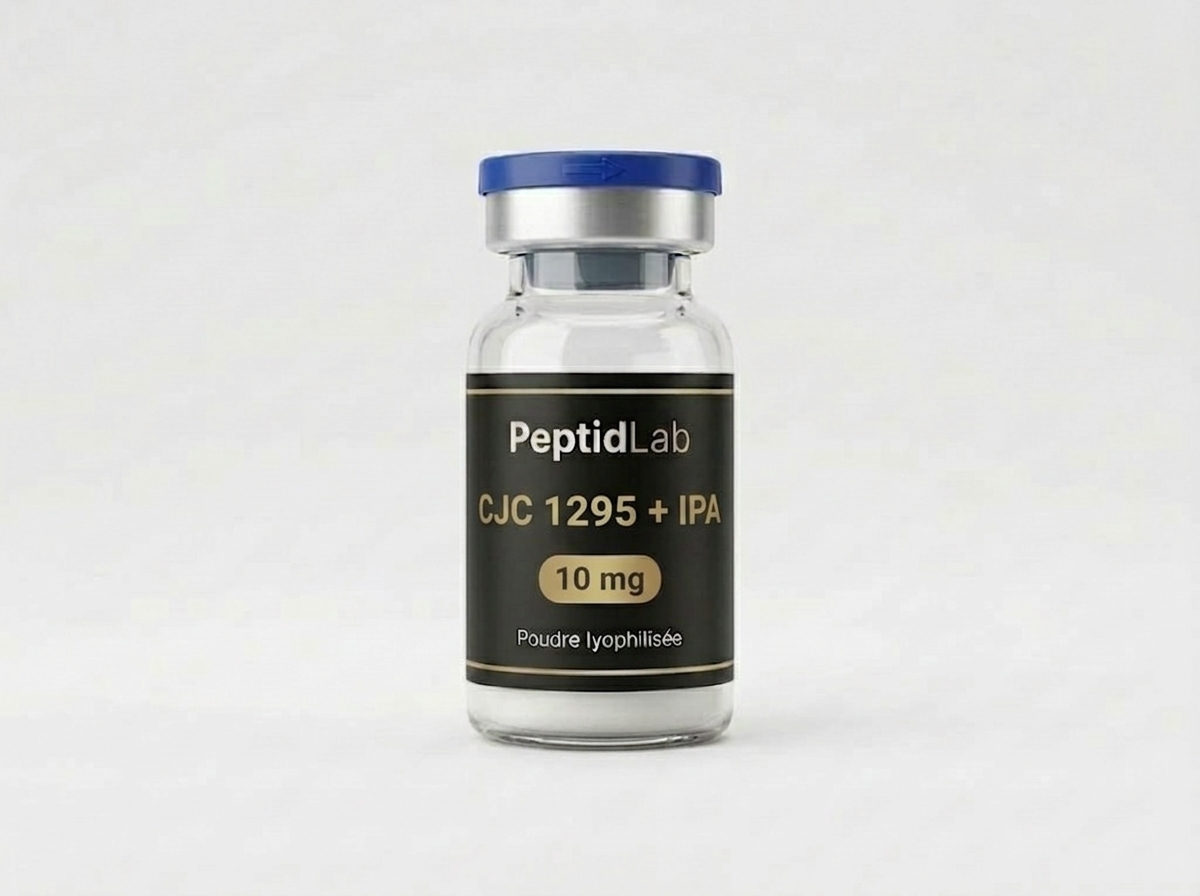
The CJC-1295 and ipamorelin are often cited together. They do not do the same job. One mimics GHRH, the other ghrelin. Both can make the pituitary release growth hormone, through two different receptors. Neither of them is HGH.
Without DAC or with DAC
The DAC (Drug Affinity Complex) binds to albumin. The form with DAC is the one for which the literature describes persistence over several days. The form without DAC (sometimes called Mod GRF 1-29) is the short form: the half-life discussed is counted in tens of minutes, not in days.
Mixing up the two names on the same label is a reading error. Our product pages keep them separate.
Ipamorelin
The ipamorelin is a pentapeptide. It acts on the ghrelin receptor (GHS-R). Studies comparing it with older GHRPs stress its selectivity: less described effect on ACTH and cortisol at the doses studied. It comes in 5 mg and in 10 mg.
The CJC-1295 + ipamorelin blend
The vial CJC-1295 + Ipamorelin 10 mg combines the form without DAC and ipamorelin. The exact ratio is that of the batch, not a convention to guess. For a concentration calculation, start from the total mass shown, then from the certificate.
To place these molecules relative to the hormone itself: HGH and tesamorelin.
Frequently asked questions
Are CJC-1295 without DAC and Mod GRF the same thing?
In the research trade, both names refer to the short GHRH analogue, without Drug Affinity Complex. Still check the sequence on the batch certificate.
Does the 10 mg blend mean 10 mg of each?
No. 10 mg is the total mass of the vial. The share of each peptide is the one written on the label and the batch document.
Fact sheet
- CJC-1295 with DAC
- GHRH (1-29) analogue bound to an albumin affinity complex
- N° CAS du CJC-1295
- 863288-34-0
- Published half-life
- CJC-1295 with DAC: 5.8 to 8.1 days; without DAC: about 30 minutes; ipamorelin: about 2 hours
- Ipamorelin
- Secretagogue pentapeptide, ghrelin receptor agonist
- CAS number of ipamorelin
- 170851-70-4
- Anti-doping status (WADA)
- Prohibited at all times (class S2)
What the research says
Summary of published data, written by the PeptidLab team. It describes molecules studied in the laboratory or in clinical trials: nothing here is an indication for use.
1998PreclinicalEur J Endocrinol
Ipamorelin is described as the first selective growth hormone secretagogue: in animals, it does not raise ACTH or cortisol, even at high doses.
2006Phase 1J Clin Endocrinol Metab
A single injection of CJC-1295 with DAC increases GH 2- to 10-fold for at least 6 days and IGF-1 1.5- to 3-fold for 9 to 11 days in healthy adults.
2006Human studyJ Clin Endocrinol Metab
Under CJC-1295, growth hormone secretion remains pulsatile: the natural rhythm is preserved, at a higher level.
2014Phase 2Int J Colorectal Dis
A trial of ipamorelin against postoperative ileus showed no benefit over placebo.
Safety: what studies report
- Clinical development of CJC-1295 was stopped by its manufacturer in 2006. Published trials mainly describe injection-site reactions, hot flushes and headaches.
Sources
Links to PubMed or to the original document. Articles in English.
- Raun K et al. Ipamorelin, the first selective growth hormone secretagogue. Eur J Endocrinol, 1998. PubMed
- Teichman SL et al. Prolonged stimulation of growth hormone (GH) and insulin-like growth factor I secretion by CJC-1295, a long-acting analog of GH-releasing hormone, in healthy adults. J Clin Endocrinol Metab, 2006. PubMed
- Ionescu M, Frohman LA. Pulsatile secretion of growth hormone (GH) persists during continuous stimulation by CJC-1295, a long-acting GH-releasing hormone analog. J Clin Endocrinol Metab, 2006. PubMed
- Beck DE et al. Prospective, randomized, controlled, proof-of-concept study of the ghrelin mimetic ipamorelin for the management of postoperative ileus in bowel resection patients. Int J Colorectal Dis, 2014. PubMed
Updated October 2026.
This guide has an informative and scientific purpose. PeptidLab products are intended exclusively for laboratory research and are not intended for human or animal consumption.