Human growth hormone is a chain of 191 amino acids. The fragment 176-191 keeps only the end, on the C-terminal side. Laboratory work on this portion concerns lipolysis: in the models studied, it acts on the adipocyte without reproducing the whole hormone's effect on IGF-1. So it is not "HGH in smaller form", and the catalogue's HGH page does not apply here.
The neighbouring molecule is called AOD9604. It is segment 177-191, plus a tyrosine added at the start of the chain. This tyrosine changes the molecule. Human trials of AOD9604, mostly by mouth or intravenously, are not trials of this fragment, and they do not set its subcutaneous dose. Copying them here would mix up two products.
The product page schedule
There is no clinical trial that has set a subcutaneous dose for the 176-191 sequence. The catalogue page uses the research schedule applied to this vial, once a day, on an empty stomach, because a meal raises insulin and insulin slows lipolysis:
- Weeks 1 to 2: 250 µg (0.25 mg), once a day.
- Weeks 3 to 8: 500 µg (0.50 mg), once a day.
No second dose during the day on this page, and no increase beyond 500 µg. The table is on the protocol sheet.
The 10 mg vial
10 mg in 2 mL gives 5 mg/mL, i.e. 5,000 µg/mL.
- 250 µg = 0.05 mL = 5 U-100 units.
- 500 µg = 0.10 mL = 10 units.
At 500 µg per day, the 10 mg vial covers about twenty doses, not counting what remains in the syringe hub. Note the reconstitution date on the label, keep the solution between 2 and 8 °C, and do not shake the vial: a peptide of this size precipitates if treated like an ordinary solution.
The morning routine
On an empty stomach means away from a meal, not "with coffee". Prepare the syringe, inject, and wait before eating. The 250 µg step is used to check that the solution is properly reconstituted and that the volume can be read. It is not skipped to go to 500 µg on day one. Eight weeks, then stop on this page: it does not describe an automatic second cycle.
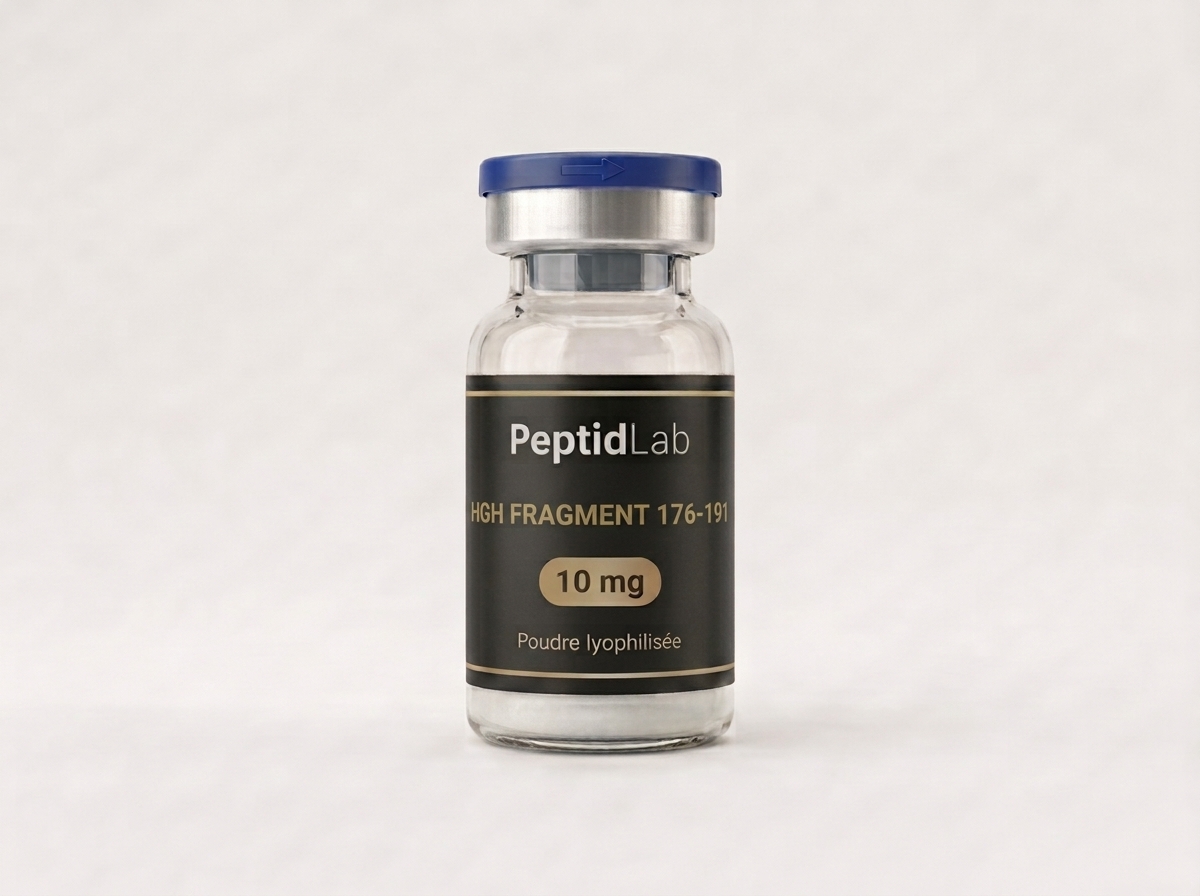
The vial: fragment 176-191, 10 mg.
Frequently asked questions
Why not reuse AOD9604 doses?
Because it is not the same sequence. AOD9604 adds a tyrosine and was studied mostly by mouth or intravenously. Those trials do not dose the 176-191 fragment.
Does this fragment replace HGH?
No. It is a piece of the chain, studied separately, without the whole hormone's effect on IGF-1. The catalogue's HGH is a different page, in international units.
Why on an empty stomach?
Insulin from a meal slows lipolysis. The page's schedule therefore places the dose away from meals, once a day.
Is 250 µg a clinical-trial dose?
No. No trial has set the subcutaneous dose of this sequence. 250 then 500 µg is the page's research schedule, not a medicine label.
Fact sheet
- Fragment 176-191
- C-terminal sequence of growth hormone, 16 amino acids (YLRIVQCRSVEGSCGF)
- AOD9604
- Fragment 177-191 preceded by a tyrosine
- Molar mass
- Fragment 176-191: about 1,817 g/mol; AOD9604: about 1,815 g/mol
- Regulatory status
- No marketing authorisation
- Anti-doping status (WADA)
- Prohibited at all times (class S2, growth hormone fragments)
What the research says
Summary of published data, written by the PeptidLab team. It describes molecules studied in the laboratory or in clinical trials: nothing here is an indication for use.
2000PreclinicalHorm Res
The lipolytic fragment of growth hormone (AOD9604) increases lipolysis in animals with no effect on blood glucose or growth.
2001PreclinicalEndocrinology
In obese mice, AOD9604 reduces fat mass, including in mice lacking the beta-3 adrenergic receptor.
2013Human studyJ Endocrinol Metab
Summary of six human trials: AOD9604 is well tolerated and does not change IGF-1. However, a phase 2b trial did not show greater weight loss than placebo.
Safety: what studies report
- For AOD9604, human trials found no notable adverse effect compared with placebo. Fragment 176-191 has no published human data.
Sources
Links to PubMed or to the original document. Articles in English.
- Ng FM et al. Metabolic studies of a synthetic lipolytic domain (AOD9604) of human growth hormone. Horm Res, 2000. PubMed
- Heffernan M et al. The effects of human GH and its lipolytic fragment (AOD9604) on lipid metabolism following chronic treatment in obese mice and beta(3)-AR knock-out mice. Endocrinology, 2001. PubMed
- Stier H et al. Safety and Tolerability of the Hexadecapeptide AOD9604 in Humans. J Endocrinol Metab, 2013. PubMed
Updated October 2026.
This guide has an informative and scientific purpose. PeptidLab products are intended exclusively for laboratory research and are not intended for human or animal consumption.