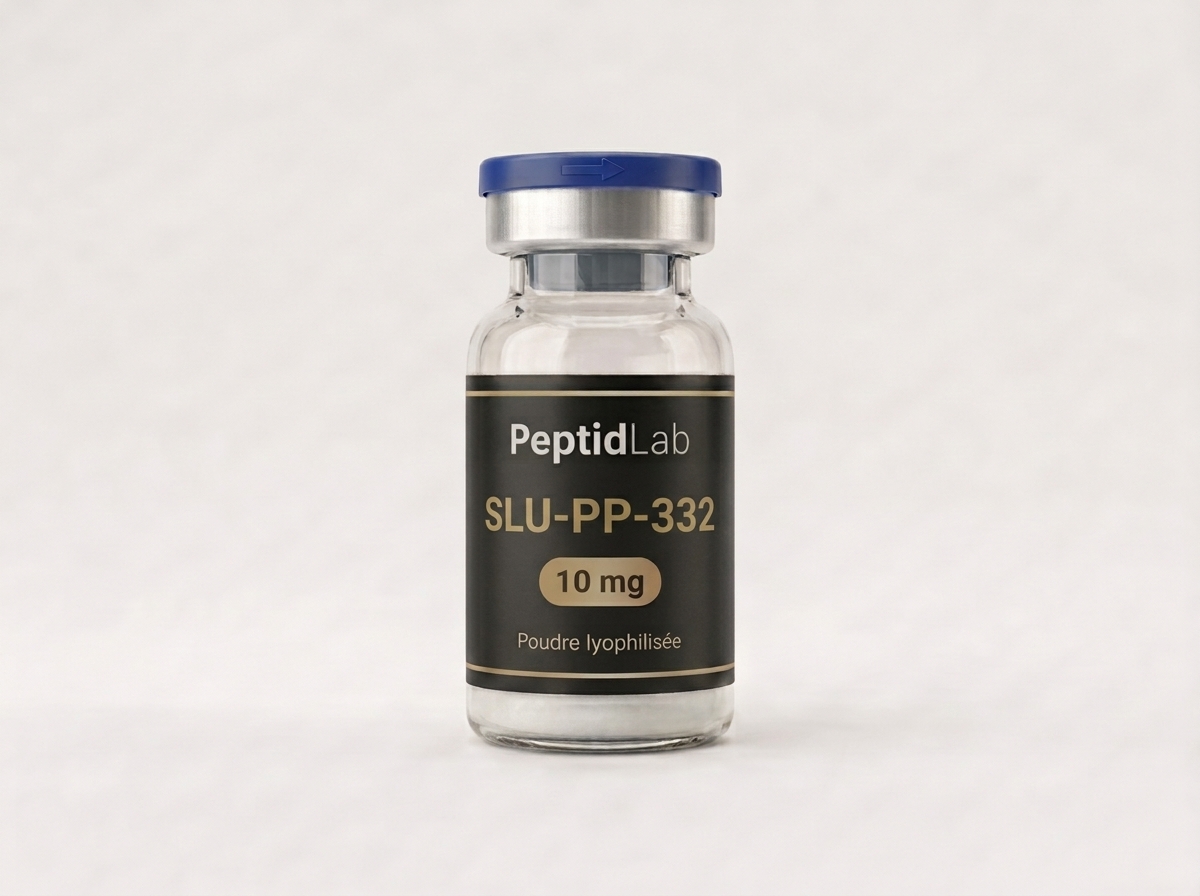
The SLU-PP-332 is not a peptide. It is a small synthetic molecule that activates the oestrogen-related receptors ERRα, ERRβ and ERRγ. These receptors do not bind oestrogens: inside the cell, they regulate genes linked to fat oxidation and the production of mitochondria. The Billon and Burris team used them as the target of a chemical "mimic" of exercise, first in culture, then in mice.
The 10 mg vial exists because the molecule can be lyophilized like a reagent. That does not make it a peptide, and it does not turn the animal trial into a human schedule.
What the article actually did
In the Journal of Pharmacology and Experimental Therapeutics (2024), and in the 2023 preprint on exercise capacity, the mice receive the molecule intraperitoneally, not under the skin, and the dose is in milligrams per kilo of mouse.
- 50 mg/kg, twice a day, for 28 days, in C57BL/6J mice, including on a high-fat diet.
- The same rhythm for 12 days in ob/ob mice: the trial was shortened, as the animals tolerated two abdominal injections a day poorly.
- A single dose of 30 mg/kg to measure what passes into the muscle, two hours and six hours later. The muscle then contained around 0.6 to 0.8 µM.
- Shorter series at 25 or 30 mg/kg appear in earlier work. The schedule the page uses is that of the main article: 50 mg/kg, twice a day.
The vehicle for these injections is a mixture of Tween, DMSO and PBS. It is not the water in which a peptide vial is reconstituted. The page protocols keeps the two apart: the trial table on one side, the vial reconstitution on the other.
Why 50 mg/kg does not convert
A milligram per kilo of mouse is not a milligram per kilo of human, let alone a volume from this vial. The two species have neither the same surface area, nor the same liver, nor the same tolerated dose. Applying 50 mg/kg to a 70 kg adult would give 3.5 g per dose, twice a day: this calculation is absurd, and it appears in no trial. There is no published clinical trial in humans. So there is no microgram step to propose "in the meantime".
What the vial allows is a working concentration. 10 mg in 2 mL = 5 mg/mL. It is a laboratory figure, for weighing a solution, not a dose. The vial: SLU-PP-332, 10 mg.
Frequently asked questions
Is it a peptide?
No. It is a small-molecule ERR receptor agonist. It is lyophilized in a vial, but its chemistry is not a chain of amino acids.
What human dose?
None is published. The trial is in mice, 50 mg/kg, twice a day, by intraperitoneal injection. This figure does not convert into a vial volume.
Why mention 3.5 g?
To show the error. 50 mg/kg times 70 kg gives a huge mass, which has never been a dose. The rule is not to do this multiplication.
What is the 10 mg in 2 mL dilution for?
To obtain 5 mg/mL, a working concentration. It is not the volume of an injection.
Fact sheet
- Last name
- SLU-PP-332
- Nature
- Small molecule, not a peptide
- Molar mass
- About 290 g/mol
- Receptor or target
- Estrogen-related receptors ERRα, ERRβ and ERRγ (agonist)
- Origin
- Saint Louis University (United States)
- Regulatory status
- No marketing authorisation; no published human trial
What the research says
Summary of published data, written by the PeptidLab team. It describes molecules studied in the laboratory or in clinical trials: nothing here is an indication for use.
2023PreclinicalACS Chem Biol
In mice, SLU-PP-332 triggers a response similar to aerobic exercise and increases endurance.
2024PreclinicalJ Pharmacol Exp Ther
In obese mice, the molecule reduces fat mass and improves several markers of metabolic syndrome.
Safety: what studies report
- No human safety data have been published.
Sources
Links to PubMed or to the original document. Articles in English.
- Billon C et al. Synthetic ERRα/β/γ Agonist Induces an ERRα-Dependent Acute Aerobic Exercise Response and Enhances Exercise Capacity. ACS Chem Biol, 2023. PubMed
- Billon C et al. A Synthetic ERR Agonist Alleviates Metabolic Syndrome. J Pharmacol Exp Ther, 2024. PubMed
Updated October 2026.
This guide has an informative and scientific purpose. PeptidLab products are intended exclusively for laboratory research and are not intended for human or animal consumption.