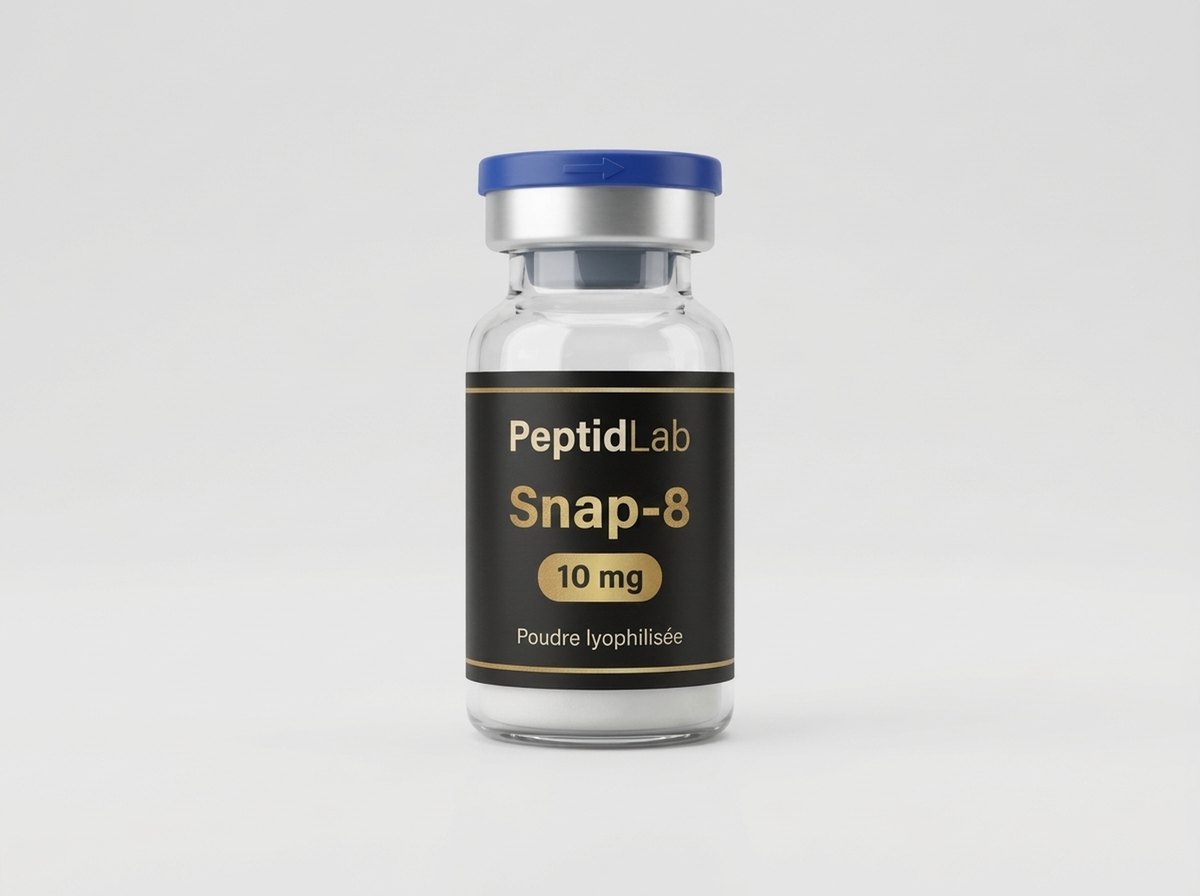
The Snap-8 is acetyl octapeptide-3. It is an extension of the hexapeptide often called Argireline: eight amino acids instead of six, with an acetyl group that makes it more stable in a formula. It is studied as a cosmetic ingredient, on expression lines, through a described effect on neurotransmitter release at the junction between nerve and muscle. The whole technical file speaks of a cream. It does not speak of a syringe.
The misunderstanding comes from a percentage. The manufacturer starts from a solution that already contains only 0.05% peptide. Incorporating 3 to 10% of this solution into a cream gives about 0.0015 to 0.005% pure peptide in the finished product. The "10%" is not 10% powder, and it is not the 10 mg vial poured as is into a jar either.
The schedule, over 28 days
- Reconstitute the 10 mg in 20 mL. This gives 0.5 mg/mL, i.e. a 0.05% solution, of the same order as the commercial solution in the file.
- Take 3 to 10% of it and incorporate it into the base, cream or gel, mixing without strong heat: a peptide is not cooked.
- Apply morning and evening, on clean skin, for 28 days, to the area studied. Let it dry.
No published trial administers this octapeptide by injection. The page protocols therefore stops at preparation and application. The five injection steps of the other peptides are deliberately not included here.
What 10 mg can prepare
10 mg of pure peptide in 20 mL is the stock solution. If 5% of it is put into a cream, 20 mL of solution is enough to prepare 400 mL of cream at about 0.0025% peptide. You do not need that volume for an eye-contour test: prepare a small batch, note the date, and keep the rest of the solution cold, between 2 and 8 °C, away from light.
A small batch, not a 400 mL jar
For a test on a small area, a few grams of cream are enough. Weigh the base, add the percentage of solution, mix cold, and label the jar with the date and percentage. The rest of the stock solution goes back to the fridge. An opened cream is not kept for months: 28 days is already the duration of the evaluation, not an expiry date to exceed.
The vial: Snap-8, 10 mg. For another peptide studied on the skin, see the guide GHK-Cu. It is not the same molecule, and percentages are not copied from one to the other.
Frequently asked questions
Is Snap-8 injected like the other peptides?
No. The file and available trials are topical. The page gives no subcutaneous volume.
Does "10%" mean 10 mg in the cream?
No. 10% refers to the share of commercial solution already dosed at 0.05% peptide. The pure peptide in the cream ends up around 0.0015 to 0.005%.
Why 20 mL and not 2 mL?
To arrive at 0.05%, the concentration of the solution in the file. 10 mg in 2 mL would make 5 mg/mL, i.e. 0.5%, ten times more. That is not the formula described.
28 days, and then?
That is the evaluation period cited in the technical file. The page does not extend it and does not make it a treatment.
Fact sheet
- Cosmetic name (INCI)
- Acetyl octapeptide-3
- Sequence
- Ac-Glu-Glu-Met-Gln-Arg-Arg-Ala-Asp-NH2 (8 amino acids)
- Molar mass
- About 1,075 g/mol
- Family
- Extension of the Argireline hexapeptide
- Use
- Cosmetic ingredient applied to the skin
What the research says
Summary of published data, written by the PeptidLab team. It describes molecules studied in the laboratory or in clinical trials: nothing here is an indication for use.
2002PreclinicalInt J Cosmet Sci
Argireline, the hexapeptide from which Snap-8 is derived, interferes with neurotransmitter release and reduced the depth of expression lines in a cosmetic study.
Data specific to Snap-8 come mainly from the manufacturer's technical file: they have not been the subject of trials published in scientific journals.
Safety: what studies report
- Applied to the skin, peptides of this family are used in cosmetics and well tolerated. Injection has never been evaluated.
Sources
Links to PubMed or to the original document. Articles in English.
- Blanes-Mira C et al. A synthetic hexapeptide (Argireline) with antiwrinkle activity. Int J Cosmet Sci, 2002. PubMed
Updated October 2026.
This guide has an informative and scientific purpose. PeptidLab products are intended exclusively for laboratory research and are not intended for human or animal consumption.