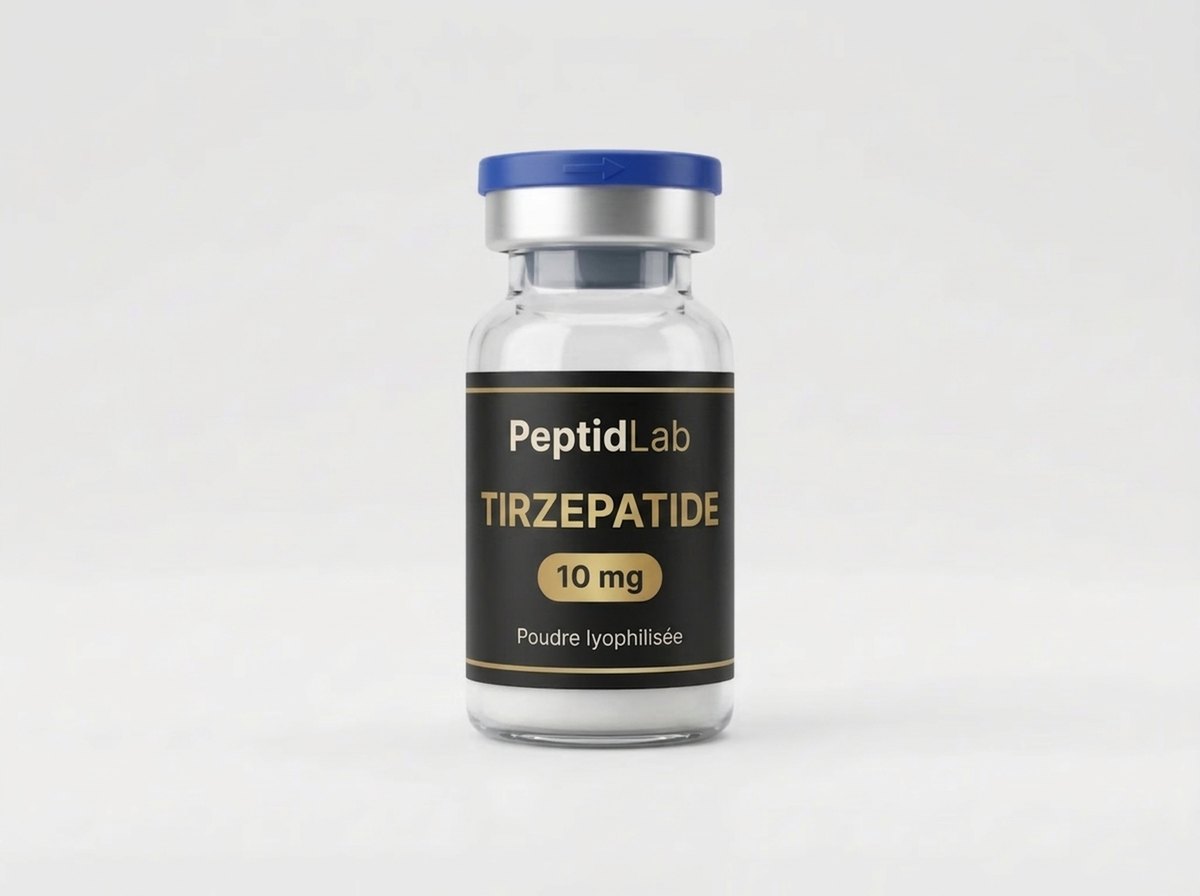
The tirzepatide is a single chain that activates two receptors: the GIP receptor and the GLP-1 receptor. Both are incretins, released after a meal. Activating them together is not "two semaglutides". The profile, dose and ceiling are not the same.
Mounjaro and Zepbound are the names of the Lilly medicines, in pens. The catalogue vial is a lyophilizate. A 60, 80 or 100 mg vial is not a pen loaded at that dose: it is a mass of powder.
The escalation, four weeks per step
SURMOUNT-1 (Jastreboff et al., New England Journal of Medicine, 2022) and the label start at 2.5 mg and go up by 2.5 mg every four weeks. The published ceiling is 15 mg once a week. You do not start at 15 mg, and you do not exceed this ceiling because the vial is bigger.
- Weeks 1 to 4: 2,5 mg
- Weeks 5 to 8: 5 mg
- Weeks 9 to 12: 7,5 mg
- Weeks 13 to 16: 10 mg
- Weeks 17 to 20: 12,5 mg
- From week 21: 15 mg
Each step lasts four weeks, on the same day. The 2.5 mg step is a start-up: in the trials, it is not the step studied for effect; it prepares the next ones. The page protocols reproduces this table and the dilutions.
Which vial for which volume
The useful step is to obtain a concentration close to 10 mg/mL, so that 2.5 mg is 0.25 mL.
- 10 mg in 1 mL, 20 mg in 2 mL, 30 mg in 3 mL: 10 mg/mL. 2.5 mg = 0.25 mL. 5 mg = 0.50 mL. 10 mg = 1 mL.
- 40 mg, 60 mg, 80 mg and 100 mg are reconstituted in 3 mL, a common vial volume. The concentration rises: 13.3 mg/mL, 20 mg/mL, 26.7 mg/mL, 33.3 mg/mL. The volume to draw for 2.5 mg becomes smaller. It is calculated; you do not "take the vial".
Holding the step
Same day every week. A forgotten dose is not made up by adding two steps. Stay on the current step. If the digestive effects of the step are too marked, the reflex in the trials is to stay four more weeks at the previous dose, not to skip the next one.
Powder and solution are kept between 2 and 8 °C, away from light. The reconstitution date is written on the label. The shelf life used on the catalogue pages after reconstitution is up to 28 to 30 days. A 100 mg vial reconstituted in 3 mL does not last longer because it is more concentrated: cold and the date count in the same way.
In the catalogue, from the 10 mg vial to the vial 100 mg. To compare the molecule with semaglutide and R3TA: the guide to the three agonists.
What the vial figure does not say
Going from 10 mg of powder to 100 mg of powder does not change the schedule. It changes the number of draws that can be made from the same solution, and the precision of the mark on the syringe. A very high concentration makes a 2.5 mg step hard to measure. That is why small vials are reconstituted more concentrated only when the volume stays readable, and large ones stay in 3 mL with a calculation, not an improvised dose.
Frequently asked questions
Mounjaro, Zepbound and the vial: what is the difference?
Mounjaro and Zepbound are fixed-dose pharmaceutical pens. The vial is a research lyophilizate. The name on the label places the molecule.
Can you take 40 mg because the vial is 40 mg?
No. 40 mg is the mass of powder. The ceiling of the published schedule is 15 mg per week, reached in 2.5 mg steps every four weeks.
Why four weeks at each step?
That is the rhythm of the trial and the label. No step is skipped, including the 2.5 mg starting step.
Are 2.5 mg of tirzepatide and 2.4 mg of semaglutide the same?
No. They are two molecules. 2.4 mg is semaglutide maintenance. 2.5 mg is only tirzepatide's first step.
Fact sheet
- Last name
- Tirzepatide
- Development code
- LY3298176
- Family
- Dual GIP and GLP-1 receptor agonist
- Structure
- 39 amino acids, C20 fatty acid chain
- Molar mass
- 4 813,5 g/mol
- N° CAS
- 2023788-19-2
- Published half-life
- About 5 days
- Developer
- Eli Lilly
- Regulatory status
- Authorised medicine (Mounjaro, Zepbound). The PeptidLab vial is not this medicine.
What the research says
Summary of published data, written by the PeptidLab team. It describes molecules studied in the laboratory or in clinical trials: nothing here is an indication for use.
2018Phase 2The Lancet
First phase 2 trial in patients with type 2 diabetes: greater reductions in blood glucose and weight than with dulaglutide at the highest doses.
2021Phase 3N Engl J Med
SURPASS-2: 1,879 patients with type 2 diabetes. At 40 weeks, all three doses of tirzepatide lowered HbA1c more than semaglutide 1 mg.
2022Phase 3N Engl J Med
SURMOUNT-1: 2,539 adults with overweight or obesity, 72 weeks. Average weight loss of 15.0%, 19.5% and 20.9% with 5, 10 and 15 mg, versus 3.1% on placebo.
2024Phase 3N Engl J Med
SURMOUNT-OSA: in adults with obesity and obstructive sleep apnoea, the number of apnoeas and hypopnoeas per hour fell markedly compared with placebo.
2025Phase 3N Engl J Med
SURMOUNT-5: head-to-head comparison with semaglutide in adults with obesity without diabetes. Weight loss of 20.2% on tirzepatide versus 13.7% on semaglutide at 72 weeks.
Safety: what studies report
- As with GLP-1 analogues, the most common adverse effects are digestive (nausea, diarrhoea, vomiting), especially during dose escalation.
- The package leaflets mention the risk of pancreatitis and gallbladder disorders.
Sources
Links to PubMed or to the original document. Articles in English.
- Frias JP et al. Efficacy and safety of LY3298176, a novel dual GIP and GLP-1 receptor agonist, in patients with type 2 diabetes: a randomised, placebo-controlled and active comparator-controlled phase 2 trial. The Lancet, 2018. PubMed
- Frías JP et al. Tirzepatide versus Semaglutide Once Weekly in Patients with Type 2 Diabetes. N Engl J Med, 2021. PubMed
- Jastreboff AM et al. Tirzepatide Once Weekly for the Treatment of Obesity. N Engl J Med, 2022. PubMed
- Malhotra A et al. Tirzepatide for the Treatment of Obstructive Sleep Apnea and Obesity. N Engl J Med, 2024. PubMed
- Aronne LJ et al. Tirzepatide as Compared with Semaglutide for the Treatment of Obesity. N Engl J Med, 2025. PubMed
Updated October 2026.
This guide has an informative and scientific purpose. PeptidLab products are intended exclusively for laboratory research and are not intended for human or animal consumption.